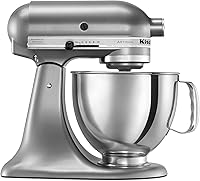
Planetary Mixer vs Spiral Mixer: What's the Difference? (November 2026)
A planetary mixer moves the attachment around a still bowl, while a spiral mixer turns the bowl under a fixed spiral hook. Pick the planetary for all-round cakes, cookies and light bread; pick the spiral when strong, well-developed dough is the main job.
On this page (10 sections)
- Planetary mixer vs spiral mixer: what actually differs?
- The two types side by side
- Which type kneads bread dough better?
- Which one handles cakes, cookies and light batters?
- What do speed settings and power mean in practice?
- Which mixer fits your counter and storage?
- Who should buy the KitchenAid Artisan?
- Who should buy the Ooni Halo Pro Spiral Mixer?
- Who should buy the KitchenAid Classic 4.5-Qt?
- Planetary mixer vs spiral mixer: which should you buy?
A planetary mixer moves the attachment around a still bowl, while a spiral mixer turns the bowl under a fixed spiral hook. That single mechanical difference shapes everything else: how the dough is kneaded, what the mixer is good at, and how much counter space it takes.
The planetary mixer vs spiral mixer question comes up most for bread bakers. A planetary machine is the all-round kitchen mixer you likely picture.
A spiral mixer borrows the kneading action of professional bakeries. Here is how to tell which one belongs on your counter.


Planetary mixer vs spiral mixer: what actually differs?
The difference is in the movement, not the motor. In a planetary mixer the bowl stays put and the attachment travels around it on a planetary path.
In a spiral mixer the bowl rotates and the spiral hook stays in place, kneading the dough against a breaker bar.
That design choice changes how firmly the dough is worked. A planetary hook sweeps the bowl and folds the dough as it goes.
A spiral hook presses and stretches the dough as the bowl turns beneath it, which develops gluten more aggressively.
The names describe the motion. "Planetary" comes from the attachment orbiting like a planet.
"Spiral" comes from the coiled hook and the turning bowl that keep the dough moving in a spiral path.
The bowl does the work in a spiral mixer
On a spiral mixer the bowl is the moving part. The Ooni Halo Pro uses a rotating bowl, a spiral dough hook and a removable breaker bar.
Ooni says this combination develops stronger gluten networks for better bread and pizza.
The breaker bar is the piece you won't find on a planetary mixer. It sits in the dough's path and adds resistance as the bowl turns, so the dough gets stretched and folded with every rotation.
The attachment does the work in a planetary mixer
On a planetary mixer the head carries the attachment around the bowl. The KitchenAid Artisan runs its coated dough hook on a planetary path across 10 speeds.
You set the speed and the head does the rest.
Because the bowl doesn't move, planetary mixers are simple to load and scrape. The tilt-head design on the Artisan and the Classic 4.5-Qt lifts the head clear so you can add ingredients with better access to the bowl.
The two types side by side
The table below lines up the key specs. Capacity and speed count come from the product data; the mixing action describes how each machine kneads.
| Product | Best for | Capacity | Speeds | Head | Our score |
|---|---|---|---|---|---|
| KitchenAid Artisan | all-round planetary mixer | 5 quarts | 10 | Tilt-head | 9.7 |
| Ooni Halo Pro Spiral Mixer 7.3-Qt | bread and pizza dough | 7.3 quarts | 58 | 8.3 | |
| KitchenAid Classic 4.5-Qt K45SS | budget planetary mixer | 4.5 quarts | 10 | Tilt-head | 8.5 |
The capacity gap is real but modest: 7.3 quarts on the Ooni against 5 quarts on the Artisan. For bread bakers the more important row is the mixing action.
The spiral hook and rotating bowl are what make the Ooni a dough-first machine.
Which type kneads bread dough better?
A spiral mixer kneads bread and pizza dough better. Its rotating bowl and fixed spiral hook work the dough harder than a hook orbiting a still bowl, so gluten develops faster and the dough comes out stronger.
That matters for stiff doughs and high-hydration doughs alike. A planetary mixer can knead a standard loaf, but the hook drags rather than presses, so the dough needs more time to reach the same development.
The spiral design is the reason professional bakeries use it. The Ooni Halo Pro brings that action home, and its breaker bar adds the extra folding that pushes gluten development further.
What the spiral hook and breaker bar do
The spiral hook kneads while the breaker bar resists. Together they stretch and fold the dough on every rotation.
The result is a dough that holds its shape and traps gas well, which is what you want before a long rise.
If you want the deeper comparison of hook shapes, our guide on the spiral dough hook vs c hook explains how each one moves through the dough.
Where a planetary mixer still kneads fine
A planetary mixer handles bread well enough for most home bakers. The KitchenAid Artisan's coated dough hook kneads on its planetary path, and 10 speeds let you start slow and build up.
Choose the planetary if bread is occasional. It kneads standard loaves without fuss and switches to the flat beater or wire whip for everything else.
Which one handles cakes, cookies and light batters?
A planetary mixer is the better choice for cakes, cookies and light batters. The attachment orbits the bowl and creams butter, sugar and eggs evenly, which is the action most cake and cookie recipes assume.
Planetary mixers were built around all-round baking. The KitchenAid Artisan's 10 speeds run from a stir setting for folding in ingredients to a high speed for whipping cream.
Its 5-quart bowl holds up to 9 dozen cookies in a single batch using the flat beater.
The Classic 4.5-Qt follows the same pattern at a smaller size. Its 4.5-quart bowl mixes up to 8 dozen cookies in a batch with the flat beater.
That makes it a sensible planetary pick for smaller households.
Can a spiral mixer make cakes and cookies?
Yes. The Ooni Halo Pro includes a flexible beater and a geared whisk alongside its spiral hook, so it can cream, beat and whip as well as knead.
Ooni lists cakes, cookies, frosting and whipped cream among the jobs its attachments handle.
The catch is that the spiral mixer is designed dough-first. If cakes and cookies are most of your baking, a planetary mixer gives you that action as the default rather than as a side function.
What do speed settings and power mean in practice?
Speed count tells you how finely you can adjust the mix; the spiral mixer offers the wider range. The Ooni Halo Pro has 58 speed settings running from 60 RPMs to over 1,000.
The KitchenAid Artisan and Classic 4.5-Qt each have 10 speeds.
For bread, a wide speed range helps. You can start the spiral hook slowly to bring the dough together, then build speed to knead without the dough climbing the hook.
The Ooni's 650 watts and 110 volts back that up.
For cakes and cookies, 10 well-spaced speeds are plenty. The KitchenAid steps cover stirring, creaming and whipping, and the knob control is easy to set by feel.
Capacity and batch size
The Ooni's 7.3-quart bowl suits larger dough batches. The Artisan's 5-quart bowl is the middle ground, and the Classic's 4.5-quart bowl is the smallest of the three.
Match the bowl to your usual batch. A 4.5-quart bowl is fine for cookies and small loaves, while a 7.3-quart bowl makes more sense if you bake several loaves or pizzas at once.
Which mixer fits your counter and storage?
A tilt-head planetary mixer is easier to park and store. The KitchenAid Artisan measures about 14.3 inches wide, 9.3 inches deep and 14 inches tall.
The Classic 4.5-Qt is narrower at about 8.7 inches wide and 13.9 inches tall.
The Ooni Halo Pro is the widest at about 17.2 inches and stands 13.5 inches tall. It also weighs more: 14.6 kg against the Artisan's 10 kg.
If counter space is tight, that size difference decides the choice.
Our guide on how much does a stand mixer weigh helps you plan for lifting and storing either type. For small kitchens, the compact stand mixer roundup covers mixers that fit under low cabinets.
Headroom for a tilt head
A tilt-head mixer needs clear space above it to lift the head. Measure the gap between your counter and the underside of your cabinets before you buy.
A spiral mixer's bowl sits under a fixed head, so its clearance needs are different.
Storage and lifting
Both types are freestanding. The lighter planetary is easier to move to a cupboard, while the heavier spiral mixer is more of a leave-it-out appliance.
Think about where it will live before ordering.
Who should buy the KitchenAid Artisan?
Buy the KitchenAid Artisan if you want one mixer for cakes, cookies and everyday bread. It is the highest-scoring mixer here because its planetary action covers the widest range of recipes, and its 10 speeds handle everything from stirring to whipping cream.
The 5-quart stainless bowl is a practical size for most households. It holds up to 9 dozen cookies in a single batch with the flat beater.
The tilt head gives you clear access to the bowl when you add ingredients.
The Artisan also comes with a coated flat beater, a coated dough hook, a 6-wire whip and a pouring shield. Its metal construction and 59 touchpoints around the bowl are built for steady mixing results.
If you want the classic tilt-head design, this is the tilt head stand mixer most buyers start with.
Who should buy the Ooni Halo Pro Spiral Mixer?
Buy the Ooni Halo Pro if bread and pizza dough are your main baking. Its rotating bowl, spiral hook and breaker bar knead dough the way a bakery does, so gluten develops faster and the dough comes out stronger.
The 7.3-quart bowl handles larger batches than the KitchenAid mixers. Ooni says the spiral mixing technology is usually found only in professional kitchens.
The 58 speed settings give you fine control from a slow start to a fast knead.
The Halo Pro also includes a flexible beater and a geared whisk, so it can make cakes, cookies and whipped cream when you want them. That makes it a dough-first mixer that still covers light baking.
Pick it when dough is the reason you are buying a mixer at all.
Who should buy the KitchenAid Classic 4.5-Qt?
Buy the Classic 4.5-Qt if you want planetary mixing on a smaller budget and a smaller counter. Its 4.5-quart bowl is sized for standard recipes, mixing up to 8 dozen cookies in a batch with the flat beater.
The 10 speeds and tilt head give you the same mixing style as the Artisan in a narrower cabinet. It includes a stainless bowl, a coated flat beater, a coated dough hook and a 6-wire whip.
It is the sensible planetary pick for small kitchens and lighter dough work.
Planetary mixer vs spiral mixer: which should you buy?
For most home bakers the KitchenAid Artisan is the better buy, because planetary mixing covers more everyday recipes. It scores highest here and handles cakes, cookies, frosting and standard bread with 10 speeds and a 5-quart bowl.
Choose the Ooni Halo Pro Spiral Mixer instead when dough is the point. Its spiral hook and rotating bowl build stronger gluten, and 58 speed settings give bread and pizza bakers more control.
If you bake bread often, the spiral design earns its place.
Choose the Classic 4.5-Qt when space and cost matter more than bowl size. It gives you planetary mixing in a smaller cabinet for lighter batches.
So the planetary mixer vs spiral mixer call is simple: planetary for all-round baking, spiral for serious dough. If you bake both, start with the Artisan and add a spiral mixer when bread becomes your main work.
If you are still weighing your options, the compact stand mixer roundup covers smaller machines for tight kitchens.
Frequently asked questions
What is the main difference between a planetary mixer and a spiral mixer?
A planetary mixer spins the attachment around a bowl that stays still, so the hook sweeps every part of the bowl. A spiral mixer keeps the hook in place and turns the bowl beneath it, which kneads dough more firmly and builds a stronger gluten network.
Which is better for bread dough, a planetary or a spiral mixer?
A spiral mixer is better for bread and pizza dough because its rotating bowl and spiral hook knead more firmly and develop gluten faster. A planetary mixer still handles bread, but it suits lighter batches and all-round baking rather than heavy, frequent dough work.
Can a planetary mixer knead dough as well as a spiral mixer?
No, not quite. A planetary mixer kneads by dragging a hook around the bowl, which works for standard recipes but is gentler on the dough.
A spiral mixer's turning bowl and fixed hook mimic professional bakery kneading, so stiff or high-hydration doughs come out stronger.
Do I need a spiral mixer for cakes and cookies?
No. A planetary mixer is the better fit for cakes, cookies, frosting and whipped cream because its moving attachment creams and whips evenly.
A spiral mixer can do those jobs with its whisk and beater, but its main strength is dough, not light batters.
Is a spiral mixer worth it for a home baker?
It is worth it if bread or pizza is your main baking and you make dough often. If you bake a mix of cakes, cookies and the occasional loaf, a planetary mixer covers more recipes and takes up less counter space.
How much space does each mixer type need?
A tilt-head planetary like the KitchenAid Artisan measures about 14.3 inches wide and needs headroom to tilt. A spiral mixer like the Ooni Halo Pro is wider at about 17.2 inches.
Measure your counter and the space above before choosing.