8 Best Stand Mixers for Beginner Bakers (October 2026)
The best stand mixers for beginner bakers include the KitchenAid Classic 4.5-Qt K45SS for first all-purpose mixer, the Cuisinart 5.5-Qt 12-Speed Stand Mixer for more room to grow, and the VIVOHOME 6-Qt Tilt-Head for larger batches.
On this page (13 sections)
- How we chose beginner stand mixers
- Which stand mixer is easiest for a beginner to use?
- Which beginner mixer gives you more bowl room?
- Which mixer suits a beginner who bakes bigger batches?
- Which mixer makes speed choices easier?
- What bowl size should a beginner choose?
- How many speeds does a first mixer need?
- Which beginner stand mixer fits a small kitchen?
- Which larger bowl mixer is still simple to learn?
- Which mixer helps control splatter?
- Which compact mixer has more speed settings?
- What should you check before buying your first stand mixer?
- Which stand mixer should a beginner baker choose?
The best stand mixer for beginners is the KitchenAid Classic 4.5-Qt K45SS for its tilt head, 10 speeds and three core tools. If you want a larger bowl, the Cuisinart offers 5.5 qt; if you have little counter or cabinet space, the Kitchen in the Box models keep capacity smaller.
A first mixer should make common recipes easier to follow, not add a complicated setup. Bowl size, speed control and included attachments are the useful basics to compare.
For a broader overview, start with our plain-English stand mixer buying guide. If your first recipes include bread, compare the best stand mixers for homemade bread too.
Our picks at a glance
-
1

-
2

-
3

How we chose beginner stand mixers
The best stand mixer for beginners has a bowl that fits likely batch sizes, familiar controls and tools for common recipes. We compared the stated capacities, speed settings, included attachments and storage notes for these eight options.
A tilt head can make it easier to reach the bowl when adding ingredients or changing tools. A dough hook, flat beater and whisk cover many starter recipes, while a splash guard can help contain dry ingredients.
Our score weighs specs, features and buyer feedback against what you're shopping for. We favor useful controls and a practical bowl size, while accounting for storage limits and whether the mixer includes the tools a new baker is likely to need.
| Product | Best for | Bowl capacity | Speeds | Included tools | Our score |
|---|---|---|---|---|---|
| KitchenAid Classic 4.5-Qt K45SS | first all-purpose mixer | 4.5 qt | 10 | Flat beater, dough hook, wire whip | 8.5 |
| Cuisinart 5.5-Qt 12-Speed Stand Mixer | more room to grow | 5.5 qt | 12 | Whisk, dough hook, flat paddle, splash guard | 8.1 |
| VIVOHOME 6-Qt Tilt-Head | larger batches | 6 qt | 10 plus pulse | Beater, dough hook, wire whip, egg separator | 7.7 |
| Hamilton Beach 4-Qt 7-Speed | simple speed guidance | 4 qt | 7 | Dough hook, whisk, flat beater | 7.3 |
| Martha Stewart 5.3-Qt Tilt-Head | a larger bowl in a slim kitchen | 5.3 qt | 12 | Whisk, dough hook, silicone-edge flat beater | 7.2 |
| bella STIR 5.3-Qt Tilt-Head | gradual speed changes | 5.3 qt | 12 | Whisk, paddle, dough hook | 6.8 |
| Kitchen in the Box 3.2-Qt | a very small kitchen | 3.2 qt | 6 | Whisk, dough hook, flat beater | 6.8 |
| Kitchen in the Box 3.5-Qt | small daily batches | 3.5 qt | 10 | Dough hook, flat beater, wire whisk | 6.7 |
Which stand mixer is easiest for a beginner to use?
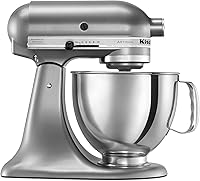
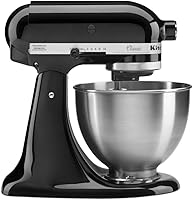
The KitchenAid Classic is the easiest all-around starting point in this group because its controls and included tools cover a range of everyday baking tasks. Beginners can use the flat beater for batters, the dough hook for dough and the wire whip for cream.
KitchenAid Classic 4.5-Qt K45SS: Best for first all-purpose mixer
- 4.5-qt stainless steel bowl
- 10 speeds
- Tilt-head access
- Flat beater, dough hook and wire whip
A straightforward set of core tools and 10 speeds covers common beginner jobs, from mixing batters to kneading dough and whipping cream.
Pros
- Tilt head gives bowl access
- Core mixing tools included
- Stainless steel bowl is dishwasher safe
Cons
- Bowl may be small for frequent large batches
- Extra attachments are sold separately
The tilt head gives access to the bowl for adding ingredients or changing attachments, and it locks in place while mixing. Its 4.5-qt stainless steel bowl is sized for regular home baking, with the maker specifying up to 8 dozen cookies in one batch.
Ten speeds let you start with a slow stir and move to faster mixing or whipping as a recipe calls for it. The box includes a coated flat beater, coated dough hook and 6-wire whip, so a beginner can try several common methods without choosing extra tools first.
This is the most balanced first pick for someone who expects to bake different kinds of recipes. If you usually make large batches, a 5.5-qt or 6-qt bowl may fit better.
Which beginner mixer gives you more bowl room?
The Cuisinart is a strong choice when you want more bowl capacity and attachments included from the start. Its 5.5-qt bowl, tilt-back head and 12 speeds give a new baker room to explore different recipes.
Cuisinart 5.5-Qt 12-Speed Stand Mixer: Best for more room to grow
- 5.5-qt stainless steel bowl
- 12 speeds
- Tilt-back head
- Whisk, dough hook, paddle and splash guard
The larger bowl and included splash guard suit a beginner who expects to bake bigger batches or wants more speed settings.
Pros
- Largest bowl among the first four picks
- Splash guard with pour spout included
- 12 speed settings
Cons
- Wider footprint than compact picks
- Optional attachments cost extra
The Cuisinart includes a chef’s whisk, dough hook, flat mixing paddle and splash guard with a pour spout. That set makes it easy to switch between whipping, kneading and mixing without building an accessory collection first.
Its bowl is larger than the KitchenAid’s, which can help when a recipe makes a generous batch. A beginner who mostly bakes one loaf or a small cake at a time may find that extra room unnecessary, and the mixer’s wider body needs more counter space.
The 12 settings offer more increments than the 10-speed KitchenAid, but the best speed still depends on the recipe and attachment. Use the included manual when learning how to set up and operate the mixer.
Which mixer suits a beginner who bakes bigger batches?
The VIVOHOME 6-Qt Tilt-Head suits a beginner who plans to make larger batches or bread more often. Its bowl is the largest in this roundup, and it comes with a beater, dough hook, wire whip and egg separator.
VIVOHOME 6-Qt Tilt-Head: Best for larger batches
- 6-qt bowl
- 10 speeds plus pulse
- Tilt head
- Beater, dough hook, wire whip and egg separator
Its 6-qt bowl and included tools suit beginners who expect to make bread or larger batches rather than small, occasional recipes.
Pros
- Largest stated bowl here
- Includes an egg separator
- Tilt head gives bowl access
Cons
- Takes more room than smaller-bowl options
- Large capacity may be unnecessary for occasional small batches
The 6-qt bowl holds more than the smaller KitchenAid and Hamilton Beach options. VIVOHOME says it can hold 3 bread loaves or 2.2 lb of flour, which makes it worth considering if your recipes regularly outgrow a standard home batch.
Its 10 speeds plus pulse control cover a range of mixing tasks, and the tilt head provides access for adding ingredients or changing attachments. The splash guard has a pour opening, while suction cups help keep the base steady during mixing.
For a beginner who bakes occasionally, the bigger bowl may take more space than needed. Choose it when the capacity matches your routine, and look at our heavy-duty stand mixer picks if you expect regular large batches.
Which mixer makes speed choices easier?
The Hamilton Beach 4-Qt 7-Speed is a simple option for a new baker who wants help choosing a setting. Its mixing guide sits on top, and its first speed is designed to start slowly.
Hamilton Beach 4-Qt 7-Speed: Best for simple speed guidance

- 4-qt stainless steel bowl with handles
- 7 speeds
- Mixing guide on top
- Dough hook, whisk and flat beater
A speed guide on top and a slow first speed give new bakers a simple starting point when following a recipe.
Pros
- Mixing guide helps choose a speed
- Built-in handle helps move the mixer
- Bowl and attachments are dishwasher safe
Cons
- Smaller bowl than several picks here
- Fewer speed settings than most picks here
The mixer includes a 4-qt stainless steel bowl with handles, a splash guard, dough hook, whisk and flat beater. That covers common starter recipes without adding a separate bowl or basic attachment purchase.
A built-in handle helps when lifting the head or moving the mixer for storage. At 8 lb, it is also lighter than some larger mixers in this roundup, though it still needs a place on the counter while in use.
The 7 speed settings are fewer than on most picks here, but a beginner may appreciate the guidance more than a long list of controls. Use the slow first speed for adding dry ingredients or beginning bread kneading, as the maker recommends.
What bowl size should a beginner choose?
Choose a 4- to 5.5-qt bowl for a flexible first mixer, or a smaller bowl if you mostly bake single recipes and need easier storage. A 6-qt bowl makes sense when larger batches are part of your plan.
The KitchenAid’s 4.5 qt is a balanced starting size for mixed use. The Cuisinart’s 5.5 qt and VIVOHOME’s 6 qt give more room for larger recipes, while the 3.2- and 3.5-qt Kitchen in the Box models suit modest batches.
Capacity alone does not tell you how much counter space a mixer needs. Check the body dimensions and weight, especially if you plan to move it between a cabinet and counter.
How many speeds does a first mixer need?
A beginner can learn on 6 or 7 speeds, while 10 or 12 speeds offer more steps between slow mixing and faster whipping. A low starting speed is helpful when adding flour or other dry ingredients.
The Hamilton Beach includes a mixing guide and a slow first speed. The KitchenAid has 10 settings, while the Cuisinart, Martha Stewart and bella models have 12.
Follow the recipe and the mixer manual when choosing a speed. If you're learning the attachments as well, our guide on how to use a stand mixer explains the common tools and speed choices.
Which beginner stand mixer fits a small kitchen?
The Kitchen in the Box 3.2-Qt is the most compact choice here, while the 3.5-Qt version adds a little bowl room and more speed settings. Both are designed for small households and limited storage.
Kitchen in the Box 3.2-Qt: Best for a very small kitchen

- 3.2-qt bowl
- 6 speeds
- Tilt head
- Whisk, dough hook and flat beater
A small footprint and light weight suit a beginner with limited storage who usually mixes modest batches.
Pros
- Compact body for limited storage
- Tilt head gives bowl access
- Includes three core tools
Cons
- Small bowl is not intended for large batches
- Only 6 speed settings
At under 7 lb and 12.9 x 7 x 10.2 in, the 3.2-qt model is easier to store than the larger picks. It has 6 speeds, a tilt head and a whisk, dough hook and flat beater.
Its small bowl is suited to modest daily use, not large batches. The brand specifically cautions against choosing it for large batch mixing, so consider a 4-qt or bigger mixer if you plan to bake for a crowd.
The 3.5-qt model has 10 speeds and is listed at 5 lb, which may appeal if you want compact storage with more speed steps. Choose between them by measuring your storage space and estimating your usual batch size.
Which larger bowl mixer is still simple to learn?
The Martha Stewart 5.3-Qt Tilt-Head gives beginners a roomy bowl and a familiar three-tool setup. Its 12 speed settings and removable splash shield add flexibility for different recipes.
Martha Stewart 5.3-Qt Tilt-Head: Best for a larger bowl in a slim kitchen

- 5.3-qt stainless steel bowl
- 12 speeds
- Tilt head
- Whisk, dough hook and silicone-edge flat beater
A mid-size bowl, 12 settings and a flat beater with a silicone edge give beginners room to try more recipes.
Pros
- Tilt head allows bowl access
- Removable splash shield
- Dishwasher-safe accessories
Cons
- Bowl is larger than needed for some small recipes
- Heavier batches still need careful speed selection
The included stainless steel whisk, dough hook and flat beater with silicone edge handle whipping, kneading and everyday mixing. The tilt head makes it easier to add ingredients or check progress, and the bowl handle helps with lifting and pouring.
Martha Stewart describes the bowl as large enough for up to 9 dozen cookies. That is more capacity than many new bakers need for a first recipe, so think about storage as well as batch size.
The slim design is intended for smaller kitchens, but the mixer still has a 5.3-qt bowl. It suits someone who wants room to grow without stepping up to the 6-qt VIVOHOME.
Which mixer helps control splatter?
The bella STIR 5.3-Qt is a good fit for beginners who want gradual speed changes and a larger bowl. Its soft-touch speed control is designed to guide those changes, and the base uses suction cups.
bella STIR 5.3-Qt Tilt-Head: Best for gradual speed changes

- 5.3-qt stainless steel bowl with handle
- 12 speeds
- Soft-touch speed control
- Suction cup base
The soft-touch control is designed to guide gradual speed changes, while the bowl handle helps with lifting and pouring.
Pros
- 12 speed settings
- Bowl has a handle
- Suction cups help keep the base steady
Cons
- Larger bowl may be more than a new baker needs
- Lightweight design may not suit buyers who want a heavier mixer
The 12-speed mixer includes a 5.3-qt stainless steel bowl with a handle, plus a whisk, paddle and dough hook. Its tilt head gives access to the bowl, while the splash shield has an access port for adding ingredients.
A beginner can start slowly when flour or powdered ingredients are involved, then increase speed as the mixture comes together. The soft-touch control is meant to make that transition more controlled and help reduce splatter.
This model has a larger capacity than a new baker may need for small recipes. Pick it if you want 5.3 qt and gradual controls, and consider a compact Kitchen in the Box if storage matters more.
Which compact mixer has more speed settings?
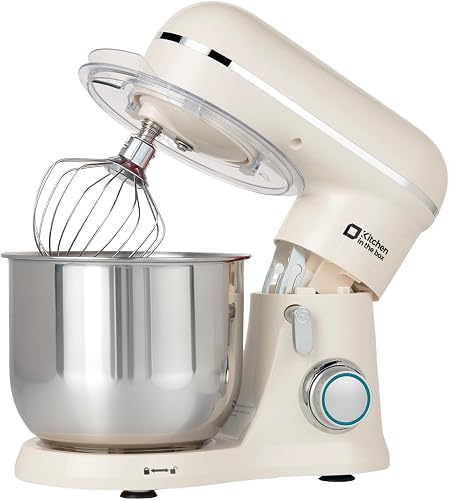
The Kitchen in the Box 3.5-Qt is the compact pick with more speed options, offering 10 settings for small everyday batches. It is aimed at small households and beginner bakers.
Kitchen in the Box 3.5-Qt: Best for small daily batches
- 3.5-qt bowl
- 10 speeds
- 300 W motor
- Dishwasher-safe accessories
This compact mixer is aimed at small households and everyday baking, with a bowl sized for modest batches.
Pros
- Compact profile for small kitchens
- 10 speed settings
- Accessories are dishwasher safe
Cons
- Small capacity limits batch size
- Not suited to frequent large batches
The 3.5-qt bowl is described as suitable for up to one loaf of bread, two pizzas or 12 cupcakes. It includes a dough hook, flat beater and wire whisk, along with a splash guard and dishwasher-safe accessories.
At 5 lb, it is designed to be easier to move than a full-size mixer. Its compact dimensions can help in an apartment kitchen, though a small bowl still limits batch size.
Choose this over the 3.2-qt model if you want 10 speeds and a little more capacity. For regular double batches or larger bread recipes, a 4.5-qt or larger mixer is a better fit.
What should you check before buying your first stand mixer?
Check bowl capacity, body size, included tools and how often you'll bake before choosing a beginner stand mixer. A machine that fits your recipes and storage is easier to keep using.
Think about the largest batch you expect to make, not only the first cake or cookie recipe. If bread is a regular goal, compare our stand mixers for homemade bread and make sure the bowl size and dough hook match your needs.
Also check whether the bowl and tools can go in the dishwasher, and where the mixer will live between uses. If you want a compact option, our compact stand mixer guide compares models for small kitchens.
Which stand mixer should a beginner baker choose?
Choose the KitchenAid Classic for a balanced first mixer with 4.5 qt, 10 speeds and three core tools. Pick the Cuisinart for more bowl space, Hamilton Beach for a simple mixing guide, or Kitchen in the Box for small batches and limited storage.
If you expect to make large amounts of bread or dough, compare bowl capacity with our guide to stand mixers for homemade bread. For a broad buying overview, return to the stand mixer buying guide.
Our top 3 picks at a glance
-
1
-
2
-
3
Frequently asked questions
What should a beginner look for in a stand mixer?
Start with a tilt head, a bowl that matches your usual batch size, and the basic tools: a flat beater, dough hook and whisk. A clear speed range also helps you follow recipes without guessing.
If storage is tight, measure the counter or cabinet before choosing a larger bowl.
Is a 4.5-qt stand mixer big enough for beginners?
A 4.5-qt bowl is a useful middle ground for many beginner recipes, including batters, cookies and smaller dough batches. The KitchenAid Classic also includes a flat beater, dough hook and wire whip.
Choose a larger bowl if you expect to bake frequent double batches.
Do beginners need a stand mixer with many speeds?
Most new bakers can start with a mixer that offers a slow setting and enough speed range for mixing, kneading and whipping. More settings can help you make smaller adjustments, but recipe steps and the right attachment matter too.
Start low when adding dry ingredients to reduce splatter.
Can a beginner stand mixer knead bread dough?
Yes, several mixers here include a dough hook for kneading. Use the speed and kneading time in your recipe or the mixer manual, and avoid overfilling the bowl.
For bread-focused advice, see our guide to stand mixers for homemade bread.