Best Stand Mixers: A Plain-English Buying Guide
The best stand mixer is the one that fits your usual recipes, batch size and kitchen space. Compare bowl capacity, head design, included tools and how often you make dense dough before choosing a model.
On this page (8 sections)
- How do you choose the best stand mixer?
- Which stand mixer size fits your baking?
- Does tilt-head or bowl-lift design suit you?
- What tools and controls should you compare?
- Four stand mixers to compare
- Is a stand mixer worth the counter space?
- What should you check before buying?
- Which stand mixer should you choose?
The best stand mixer is the one that fits your usual recipes, batch size and kitchen space. Compare its bowl, head design, included tools and capacity for the jobs you actually do before paying for features you may not use.
A mixer for occasional cakes has different needs from one used for bread dough several times a week. Start with your largest regular batch, then check whether the mixer can handle that job according to its maker.
This guide explains how to compare the main choices and highlights four models with different capacities and designs. For more options organized by use, see our stand mixer picks and category guide.
How do you choose the best stand mixer?
Choose a stand mixer by matching capacity, design and tools to your routine. Bowl size matters, but it does not tell the whole story: the mixer must also suit the kind of mixing and kneading you plan to do.
Before comparing brands, answer these questions:
- What do you make most weeks: cakes, cookies, whipped mixtures or bread?
- How large is your biggest regular batch?
- How much counter and storage space can you give the mixer?
- Which tools are included, and which would you need to buy separately?
- Does the maker describe the model as suitable for the dough or batch size you have in mind?
A stand mixer can save repeated hand mixing, but it still needs setup, cleaning and storage. A smaller model may be easier to place and handle, while a larger bowl can be useful when you regularly make more at once.
Which stand mixer size fits your baking?
The right bowl size depends on your largest regular batch and the space you have. A bigger capacity can give you room for more ingredients, but it does not automatically mean the mixer is better for every kitchen or recipe.
The models in this guide range from 5 to 6.5 quarts. Use that range as a comparison point, then check recipe quantities and the maker's batch guidance for the model you choose.
| Bowl capacity | A useful starting point | Check before choosing |
|---|---|---|
| About 5 qt | Everyday mixing and moderate batches | Whether your largest regular recipe fits |
| About 5.5 qt | A little more room for frequent home baking | The bowl's shape and included tools |
| About 6 qt | More capacity for larger batches | Counter footprint and maker's dough guidance |
| About 6.5 qt | A larger bowl for planned batch work | Whether the mixer suits your recipes and storage space |
Quarts measure bowl volume, not a guaranteed amount of flour, dough or finished food. Ingredient volume, mixing method and the shape of the bowl all affect how comfortably a recipe fits.
If bread is your main reason for buying a mixer, compare more than capacity. Our guide to stand mixers for homemade bread focuses on dough needs, and the pizza dough mixer guide covers that specific use.
Does tilt-head or bowl-lift design suit you?
A tilt-head mixer lets you move the head back to reach the bowl; a bowl-lift mixer raises the bowl toward the tool. Choose the arrangement that fits your counter and how you like to add ingredients and remove the bowl.
A tilt-head layout can make bowl access straightforward, but check how much overhead clearance the raised head needs. If cabinets hang low above your counter, measure before you buy.
Bowl-lift designs hold the bowl on supports and move it into mixing position with a lever. Buyers who make large batches may prefer that arrangement, but the mixer itself can take up a different amount of room and require a different lifting motion.
The specific models below include tilt-head designs from KitchenAid, Cuisinart and VIVOHOME. The Bosch has a bottom-drive design, so compare its layout with your countertop and storage plans.
For a closer look at the two common arrangements, read our tilt-head stand mixer guide.
What tools and controls should you compare?
Start with the tools you need most: a beater for general mixing, a whisk for whipping and a dough hook for kneading. Check which tools are included with the exact model, since sets vary.
A splash guard or pouring shield can help contain ingredients while you add them. It is a practical extra, but it does not replace choosing the right bowl size or adding ingredients carefully.
Speed counts are not a simple quality score. More settings can give you more steps between slow and fast, while fewer settings may still work for someone who uses a small range of speeds.
Look for clear low-speed control if you often add flour or start thick mixtures.
Optional attachments can expand what a mixer does, but they may add cost and storage needs. Check the model's compatible attachments and whether the tools you want come in the box.
Our guide to KitchenAid mixer attachments explains what to consider before adding accessories.
Four stand mixers to compare
These four choices show different bowl sizes, controls and mixing layouts. Match the details to your own use, and check each manufacturer's instructions for recipe limits and care.
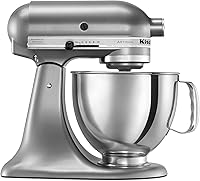
KitchenAid Artisan: 5 qt tilt-head
The KitchenAid Artisan suits buyers who want a 5 quart tilt-head mixer with 10 speeds. Its control ranges from a very fast whip to a very slow stir, and the mixer includes a pouring shield.
This is the smallest bowl among the four choices here. Consider it if your common recipes fit a 5 quart bowl and you want direct access to the bowl by tilting the head back.
The mixer also has an accessory hub for optional attachments, which are sold separately. The included-components details name the stand mixer, so confirm which tools come with the particular package you plan to buy.
Choose it if the 5 quart capacity suits your usual batches and you prefer the tilt-head format. If you often make large quantities of dough, compare the maker's guidance with your recipes before deciding.
Bosch Universal Plus: 6.5 qt bottom drive
The Bosch Universal Plus suits buyers who want a 6.5 quart bowl and dough-focused accessories. Its package includes wire whips, a dough hook, a splash ring, a bowl lid and a dough hook extender.
Its bottom-drive layout differs from the tilt-head mixers here. The bowl is BPA-free plastic with a handle and removable drive shaft, and it is described as dishwasher safe.
The mixer has four variable speeds plus pulse. The maker describes its capacity for large batches of bread dough and cookies, but you should check its instructions against the size of your own recipe.
Choose it if you want the larger bowl and included dough tools, and its layout fits your kitchen. The bowl material and control setup are different from the other models in this guide, so consider those details before choosing.
For more options aimed at larger batches, compare our heavy-duty stand mixer guide.
Cuisinart: 5.5 qt and 12 speeds
The Cuisinart suits buyers who want a 5.5 quart stainless steel bowl, 12 speeds and a tilt-back head. It includes a chef's whisk, dough hook, flat paddle and splash guard with pour spout.
Its listed motor power is 500 watts, and its construction is die-cast metal. The bowl and accessories are described as dishwasher safe.
The 5.5 quart capacity sits between the KitchenAid and Bosch in this group. The extra speed settings may appeal if you want more control choices, but consider whether the included tools and bowl size match the recipes you make.
Choose it if you want a stainless steel bowl, a tilt-back head and the three named tools in the package. If price is a key limit, see our stand mixers under 200 dollars guide.
VIVOHOME: 6 qt tilt-head
The VIVOHOME suits buyers looking for a 6 quart tilt-head mixer with 10 speeds and pulse. Its included tools are a stainless steel whisk, aluminum hook, beater and egg separator.
The model has a steel bowl and suction cups intended to help it stay in place during mixing. Its splash guard has an opening for adding ingredients, and the package includes a flex edge beater.
Choose it if you want a larger bowl than 5 or 5.5 quarts and prefer a tilt-head design. Compare its dimensions with your counter and storage space before choosing, especially if your work area is narrow.
Is a stand mixer worth the counter space?
A stand mixer is useful when you repeat mixing or kneading jobs often enough to justify its footprint. It may be less useful if you bake only occasionally, make small batches or have nowhere convenient to store it.
Consider the work it would replace. If you regularly whip, cream or knead by hand, a stand mixer can keep the tool in place while you prepare other ingredients.
If your recipes are mostly quick batters, a hand mixer may be easier to store and bring out.
A stand mixer also needs room around it. Measure its footprint, allow for head or bowl movement and check whether you can reach the controls without moving other appliances.
For a brand-specific buying question, read whether KitchenAid stand mixers are worth it. If you are weighing a mixer against another appliance, our stand mixer vs food processor comparison explains which jobs suit each.
What should you check before buying?
Check the exact model name, dimensions, included tools and maker's instructions before you order. Models within one brand can differ, and a bundle may include accessories that are not part of every package.
Use this short checklist:
- Measure the counter area and any cabinet clearance above it.
- Check the bowl capacity and the recipe size you plan to make most.
- Confirm the design gives you enough access to add ingredients and remove the bowl.
- Verify that the tools you need are included.
- Check the maker's guidance for dough, batch size, care and compatible attachments.
- Make sure you have a place to store any optional tools.
A listed wattage, speed count or bowl volume does not tell you everything about how a mixer handles a specific recipe. When the maker gives a batch limit, use that model-specific guidance rather than relying on a general rule.
Which stand mixer should you choose?
Pick the mixer by your main job and your available space. Choose a 5 to 5.5 quart tilt-head if that capacity and layout suit your regular baking; compare the larger Bosch or VIVOHOME bowls if you want more room, while checking maker guidance for your recipes.
If bread dough is your main concern, start with our homemade bread mixer guide and check the model's dough instructions. For a small kitchen, compare the options in our compact stand mixer guide.
More stand mixer guides
Use these related guides to narrow the choice by job, size or brand:
- Best stand mixers for homemade bread
- Best stand mixers for pizza dough
- Best stand mixers under 200 dollars
- Best heavy-duty stand mixers
- Best tilt-head stand mixers
- Best compact stand mixers
- Best stand mixers for beginner bakers
- How to use a stand mixer
- How long to knead dough in a stand mixer
- What a stand mixer is used for
- What wattage a stand mixer should have
- How to clean a KitchenAid mixer
- Can you mix sourdough in a stand mixer?
- How to use a KitchenAid dough hook
- How to make mashed potatoes with a mixer
- How much a stand mixer weighs
- How to make whipped cream in a stand mixer
- Bread machine vs stand mixer
- Spiral dough hook vs C-hook
- KitchenAid Artisan vs Artisan Mini
- KitchenAid vs Bosch mixer
- VIVOHOME 6 quart stand mixer review
- Bosch Universal Plus mixer review
- Hamilton Beach 4 quart stand mixer review
- Best stand mixer brands
- Compare KitchenAid mixer models
- Bread and dough guides
- Stand mixer sizes and power
- Stand mixer techniques and uses
- Stand mixer brands and matchups
Frequently asked questions
What is the best stand mixer for most home bakers?
The best stand mixer for most home bakers is one that fits the batches they make most often and has the tools they need. A 5 to 6 quart bowl is a useful starting point for many kitchens, but frequent large batches or dense bread dough can call for a different design and capacity.
How many quarts should a stand mixer be?
Choose bowl size based on your largest regular batch, not an occasional recipe you might try. A 5 to 5.5 quart mixer can suit everyday home baking, while a 6 to 6.5 quart bowl offers more room.
Check each recipe and the mixer maker's guidance for practical batch limits.
Is a tilt-head or bowl-lift stand mixer better?
A tilt-head mixer gives you access to the bowl by moving the head back, while a bowl-lift model raises the bowl toward the mixing tool. Pick the arrangement that feels easier in your kitchen and fits your counter clearance, bowl handling and usual recipes.
Can a stand mixer knead bread dough?
Many stand mixers include a dough hook, but their capacity and design affect how much dough they can handle. Check the maker's guidance for your specific model and recipe, and avoid assuming that a larger bowl alone means a mixer is suitable for heavy dough.
What attachments come with a stand mixer?
Common included tools are a flat beater, whisk and dough hook, but the set varies by model. Some mixers also come with a splash guard or pouring shield.
Read the included-components details for the exact model, and treat optional attachments as separate purchases unless they are named in the box contents.