Can You Use a Stand Mixer for Pasta Dough?
Yes, a stand mixer can mix and knead pasta dough. Run it on the slowest speed until the flour hydrates and the dough balls up, then rest it and finish by hand. The mixer does the hard kneading, and you keep control of the final texture.
On this page (9 sections)
- Can you use a stand mixer for pasta dough?
- How do you mix pasta dough in a stand mixer step by step?
- Which mixer tools should you use for pasta dough?
- How do you know when pasta dough is mixed enough?
- What changes when you use a stand mixer for pasta dough?
- Can you roll and cut pasta with a stand mixer attachment?
- What mixer suits pasta dough best?
- Which mistakes should you avoid with mixer pasta dough?
- The short answer on using a stand mixer for pasta dough
Yes, you can use a stand mixer for pasta dough. The machine mixes and kneads the dough, then you shape and roll it by hand.
That saves the mess and the arm work, and the result is a smooth, elastic dough.
The key is knowing where the mixer helps and where it stops. Pasta dough is stiffer than bread, so you run the mixer only until the dough comes together.
Can you use a stand mixer for pasta dough?
Yes, a stand mixer handles pasta dough well when you mix on the lowest speed. Most doughs come together in 2 to 4 minutes.
Run it any longer and the dough heats up and turns tough.
Pasta dough is a simple mix: flour and eggs, sometimes a little olive oil or water. It's a firm, low-hydration dough compared with bread, which is exactly why a mixer helps.
A dough hook does the lifting, and you skip the sticky-hands stage.
The bonus is consistency. A mixed dough hydrates evenly, so you get fewer dry patches when you roll it out.
That matters most with a rolling pin or a manual roller.
Your stand mixer's slow speeds are the ones to use. Start on stir, then move to the lowest kneading setting only if the dough needs it.
For the timing, see how long to knead dough in a stand mixer.
How do you mix pasta dough in a stand mixer step by step?
Add flour to the bowl, run the hook on the slowest speed, then stream in the eggs. Stop as soon as the dough forms a shaggy ball.
- Add 2 cups of all-purpose or "00" flour and a pinch of salt to the bowl.
- Fit the dough hook and start on the lowest speed.
- Add 3 whole eggs one at a time, letting each one blend in.
- Mix until a shaggy mass forms, about 1 to 2 minutes.
- Add a teaspoon of water if it's dusty, or a teaspoon of flour if it's sticky.
- Knead on low for 1 to 2 more minutes, then turn it out.
Keep your hand near the head at the start so the dough doesn't climb the hook. If it does, stop, push it back down, and carry on.
Finish with a short hand knead on a floured counter until the surface feels smooth. That final touch tells you more about the dough than any timer.
Which mixer tools should you use for pasta dough?
Use the dough hook, never the whisk or the flat beater. The hook is built for dense, stiff mixtures, and it's the only tool that won't strain the motor.
The standard C-shaped hook works, but a spiral hook kneads more evenly. The Mttobo Stainless Spiral Dough Hook fits 4.5-quart and 5-quart tilt-head KitchenAid mixers and pushes dough down as it turns.
It's stainless steel, so it won't chip like a coated hook, and it's dishwasher safe. It's not compatible with bowl-lift mixers, so check your model fits before you buy.
The flat beater is the wrong call: it smears the dough against the bowl instead of kneading. The whisk is worse, since stiff dough can bend the tines.
Stick with the hook for every pasta dough.
How do you know when pasta dough is mixed enough?
Stop mixing when the dough forms a rough ball and clears the bowl sides. The surface can look a little uneven; it will smooth out during the rest.
Press it with a finger. It should feel firm and slightly tacky, not sticky enough to coat your hand.
If it clings to the bowl, add a spoon of flour and run the hook for 20 seconds.
If it stays crumbly, sprinkle water a teaspoon at a time and pulse. The dough should come together in your hand when you squeeze a lump.
The window is narrow with pasta. Over-mixed dough feels tight and springs back when you roll it, which makes thin sheets hard to reach.
Under-mixed dough tears easily.
Give it a 30-minute rest, wrapped, before you roll. That rest does the last bit of work for you.
What changes when you use a stand mixer for pasta dough?
The mixer saves time and effort, but it can overwork a small batch. Low-hydration doughs heat up faster than bread, so short bursts beat long kneading.
You use less flour on the counter, since the bowl holds the mess. That's a real plus in a small kitchen.
Cleanup is one bowl and one hook.
The trade-off is feel. Mixing by hand lets you judge the dough as it forms; with a machine you check less often.
Keep stopping to squeeze a lump.
Batch size matters too. A single-egg dough may sit under the hook and get pushed around rather than kneaded.
Make a larger batch, or scrape down and mix by hand at the end.
A stand mixer is a fine tool for pasta dough, not a shortcut around the rest step. For more on mixing technique, see can you mix sourdough in a mixer, which covers the same slow-speed habits.
Can you roll and cut pasta with a stand mixer attachment?
Yes, the KitchenAid pasta attachment turns the mixer into a roller and cutter. It powers the machine from the front hub and makes quick work of fresh sheets.
The KitchenAid KSMPRA 3-Piece set includes a roller, a fettuccine cutter, and a spaghetti cutter. It fits all household KitchenAid stand mixers, and the stainless rollers have 8 thickness settings.
Run the dough through the widest setting first, dusting with flour between passes. Step down one setting at a time until you reach the thickness you want.
Keep the dough firm, or it can clog the rollers.
Hand wipe the parts only; the cleaning brush is there for flour dust. The cutters are sharp, so take your time when you fit them.
On a 5-quart tilt-head, this turns one machine into a full pasta station. That's the case for a mixer if you plan to make pasta often.
What mixer suits pasta dough best?
A 5-quart tilt-head mixer has the power and capacity for family-size pasta batches. It kneads stiff dough without slowing and leaves room for the dough to move.
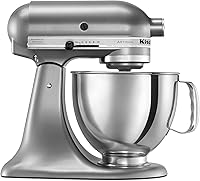
The KitchenAid Artisan 5-Quart Tilt-Head KSM150PS has 10 speeds and a slow first setting, which is what you want with a firm dough. The tilt-head design makes it easy to add eggs and scrape the bowl.
The pouring shield helps keep flour in the bowl at the start, when the hook is spinning dry ingredients. It also has a front hub for attachments, so the pasta roller plugs right in.
If you bake bread too, the same machine kneads those doughs. Our guide to the stand mixer for pizza dough covers the doughs that push a mixer hardest.
Wondering if you need one at all? Read do you need a stand mixer to make bread first.
If you make pasta weekly, the mixer earns its counter space.
Which mistakes should you avoid with mixer pasta dough?
Don't over-mix, skip the rest, or roll sticky dough. Each one costs you a smooth sheet, and each one is easy to fix.
Keep these in mind:
- Run the mixer on the lowest speed; high speed heats and toughens the dough.
- Add liquid in small amounts, since pasta dough is easy to wet too much.
- Rest the dough for 30 to 60 minutes before rolling.
- Flour the dough lightly between roller passes, not the machine.
- Cut and cook fresh pasta soon, or dry it on a rack.
If the dough fights the roller, rest it again for 10 minutes. That relaxes the gluten and lets the sheet stretch without tearing.
Room-temperature eggs blend more evenly, so take them out early. Weighing flour beats scooping for consistency, especially if you make pasta often.
The short answer on using a stand mixer for pasta dough
Can you use a stand mixer for pasta dough? Yes, and it's a smart way to mix it.
Run the dough hook on the slowest speed, stop when the dough balls up, then rest and roll it.
Pick the KitchenAid Artisan 5-Quart if you want one mixer for pasta and bread. Add the KitchenAid 3-Piece Pasta Roller and Cutter Set to roll and cut at the machine.
Choose the Mttobo Spiral Dough Hook if you want a stiffer knead on a tilt-head model.
Keep the batch size sensible, mix in short bursts, and let the dough rest. Those three habits make mixer pasta dough dependable.
Then the only job left is choosing a sauce.
Frequently asked questions
How long should pasta dough rest after mixing?
Rest it for at least 30 minutes, covered, so the flour fully hydrates and the gluten relaxes. A rested dough rolls thinner without springing back.
An hour is better if your schedule allows it.
Why is my pasta dough too crumbly after using the mixer?
Crumbly dough usually needs a splash of water, added a teaspoon at a time. Press the dough together; if it won't form a ball, sprinkle water and run the hook briefly.
If it sticks badly, add a little flour.
Can you use the pasta roller attachment on any dough?
It works on rested pasta dough, not bread or cookie dough. Feed dough through on the widest setting first, dust with flour, and roll thinner in steps.
Too-sticky dough can clog the rollers, so keep it firm.