KitchenAid Mixer Models Compared Side by Side
The main differences between KitchenAid mixer models are bowl size and head style: the Classic and Artisan tilt, while the 5.5 and 7 qt models use a bowl-lift design. Match capacity and included tools to your usual batches.
On this page (6 sections)
KitchenAid mixer models differ mainly in bowl capacity and head style: the Classic and Artisan are tilt-head models, while the 5.5 and 7 qt models are bowl-lift designs. Compare your usual batch size, access preference and included tools before choosing.
The Classic has a 4.5 qt bowl and 10 speeds, while the Artisan adds half a quart and a pouring shield. The bowl-lift options step up to 5.5 or 7 qt, with 11 speeds and a half-speed setting for folding.
For a broader look at brand trade-offs, see our stand mixer brands guide. If you’re deciding whether the brand fits your needs, our guide to whether KitchenAid mixers are worth it covers that question.
How do the KitchenAid mixer models compare?
The Classic and Artisan tilt-head models offer 4.5 and 5 qt bowls; the 5.5 and 7 qt models use a bowl-lift design and have larger capacities. All four examples include a bowl, flat beater, dough hook and wire whip, with some differences in extras and speed settings.
| Model | Bowl | Head style | Speeds | Notable included tools |
|---|---|---|---|---|
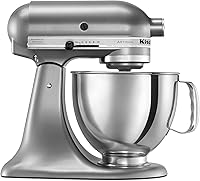
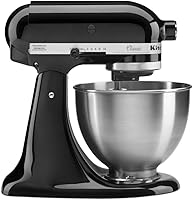
| Classic K45SS | 4.5 qt | Tilt-head | 10 | Coated flat beater, coated dough hook, 6-wire whip |
| Artisan KSM150PS | 5 qt | Tilt-head | 10 | Pouring shield highlighted; mixer included |
| 5.5 qt KSM55 | 5.5 qt | Bowl-lift | 11 | Coated flat beater, coated dough hook, 6-wire whip |
| 7 qt KSM70SKXX | 7 qt | Bowl-lift | 11 | Double flex edge beater, coated flat beater, coated dough hook, 11-wire whip, pouring shield |
The Classic and Artisan both have a tilt-head, which lifts to give you access to the bowl. The 5.5 and 7 qt bowl-lift designs hold the bowl in a three-point lock, according to KitchenAid’s model descriptions.
If counter space matters, compare the dimensions before deciding. The Classic and Artisan examples measure 14.1 in deep, 8.7 in wide and 13.9 in high; the bowl-lift examples are 14.63 in deep, 11.31 in wide and 16.5 in high.
Which KitchenAid model suits a regular baking routine?
For standard recipes and smaller batches, start with the Classic or Artisan. Choose between them based on whether the Artisan’s extra half quart and pouring shield are useful to you.
The Classic is described for mixing up to 8 dozen cookies in one batch using its flat beater. That example helps put the bowl size in context, though your recipe and ingredient proportions affect the actual batch that fits.
The Artisan has a 5 qt bowl and 10 speeds. KitchenAid describes it for batches of up to 9 dozen cookies using the flat beater, and its highlighted features include a pouring shield.
Both examples include a flat beater, dough hook and wire whip, though the Classic’s listed components specify coated beaters and a 6-wire whip. The Artisan’s included components are described as a stand mixer, so check the exact included tools for the model and configuration you choose.
For recipes that often involve dough, consider how batch size affects your choice. Our guide to stand mixers for homemade bread compares options with bread baking in mind.
What changes when you choose a bowl-lift KitchenAid?
The 5.5 and 7 qt bowl-lift models give you more bowl capacity and 11 speeds, including a half-speed setting for folding. Both use a 3-point locking bowl; their size and included tools help separate one from the other.
KitchenAid describes the 5.5 qt model for mixing 11 dozen cookies, kneading over 7 lb of bread or mashing 6 lb of potatoes. The recipe and tool matter, so treat those as capacity examples rather than a promise for every mixture.
The 7 qt model is the largest bowl in this comparison. KitchenAid describes it for up to 13 dozen cookies, over 8.5 lb of bread or over 7.5 lb of potatoes, and it includes a double flex edge beater and an 11-wire whip.
The 5.5 qt model includes a 6-wire whip, while the 7 qt model includes an 11-wire whip. Both include a coated flat beater and coated dough hook, but the 7 qt model also includes a pouring shield and double flex edge beater.
The bowl-lift models are taller and wider than the tilt-head examples. Measure your counter clearance and storage space if you plan to move the mixer between uses.
How should you choose between tilt-head and bowl-lift?
Choose tilt-head for direct bowl access and bowl-lift for a larger bowl with a locking support. Your normal batch size and available counter space should decide which trade-off matters more.
A tilt-head can make adding ingredients and changing tools straightforward because you raise the head. A bowl-lift keeps the head in place while the bowl moves into position, and its 3-point lock supports the bowl during mixing.
For occasional cookies, cakes and whipped mixtures, a 4.5 or 5 qt bowl may be enough. For frequent large batches or dough, compare the 5.5 and 7 qt capacities with the amounts in your recipes.
Do not choose by capacity alone. A larger bowl can take more counter space, and your smallest recipes may be less convenient if you rarely use the extra room.
Do KitchenAid mixer models share attachments?
All four models are described as compatible with optional hub-powered KitchenAid attachments, sold separately. These can include tools for tasks such as pasta making or food grinding, but the included mixing tools still vary by model.
The Classic, 5.5 qt and 7 qt examples specify a flat beater, dough hook and wire whip in the box. The Artisan description highlights a pouring shield, while the other models list their included tools more specifically.
If you’re comparing accessories, our KitchenAid attachments guide explains what those add-ons are for. Check the compatibility details for a specific attachment before buying.
Which KitchenAid mixer model should you pick?
Choose the Classic for standard recipes in a 4.5 qt bowl, the Artisan for a 5 qt tilt-head, the 5.5 qt bowl-lift for a larger everyday capacity, or the 7 qt bowl-lift for the largest batches in this group.
If you bake bread often, compare the recipe quantities with the 5.5 and 7 qt examples before choosing. For a closer look at the two tilt-head sizes, read our Artisan vs Artisan Mini comparison, then check counter clearance and included tools for the model you want.
Frequently asked questions
What is the difference between KitchenAid Classic and Artisan mixers?
The Classic has a 4.5 qt bowl, while the Artisan has a 5 qt bowl; both are tilt-head mixers with 10 speeds. Choose the Classic for standard recipes and a slightly smaller bowl, or the Artisan when the extra half quart and its included pouring shield suit your routine.
Is a bowl-lift KitchenAid better than a tilt-head model?
A bowl-lift KitchenAid may suit you better if you want a locking bowl and larger capacity, while a tilt-head model gives you access to the bowl by lifting the mixer head. The 5.5 and 7 qt examples here are bowl-lift models; the 4.5 and 5 qt examples tilt.
Which KitchenAid mixer model is best for bread dough?
For larger bread batches, compare the 5.5 and 7 qt bowl-lift models, which have larger bowls and a 3-point locking bowl. The 5.5 qt model is described for kneading over 7 lb of bread, and the 7 qt model for over 8.5 lb; use your recipe and the manual to confirm suitable batch size.
Do KitchenAid mixer models use the same attachments?
The four models described here support optional KitchenAid hub-powered attachments, which are sold separately. Their included mixing tools differ, so compare the box contents as well as hub compatibility if you plan to use a particular beater, whip or dough hook.