KitchenAid Artisan vs Artisan Mini: Size and Power (October 2026)
Choose the Artisan for its 5-quart bowl and the Artisan Mini for a lighter mixer with a smaller footprint. Both have tilt-head designs and 10 speeds, so the choice depends more on batch size and storage than on the speed controls.
On this page (6 sections)
Choose the KitchenAid Artisan for its 5-quart bowl and the Artisan Mini for a lighter, narrower mixer. Both have tilt-head designs and 10 speeds, so your usual batch size and available counter space are the clearest ways to decide.
The Artisan Mini measures 12.3 inches deep, 7.8 inches wide and 12.3 inches high. The Artisan measures 14.1 inches deep, 8.7 inches wide and 13.9 inches high.
Their bowl capacities differ by 1.5 quarts: 3.5 for the Mini and 5 for the Artisan. KitchenAid describes the Mini as lighter and easier to move, while both models have 10 speeds.
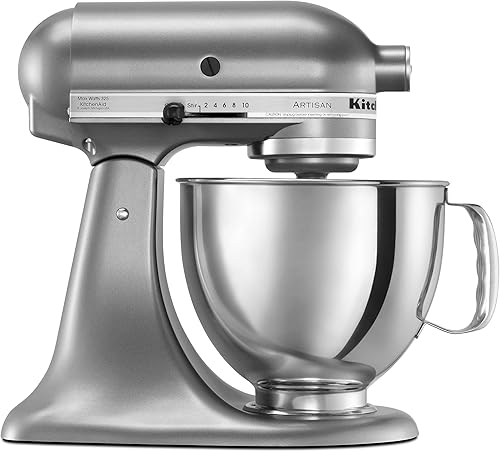

KitchenAid Artisan vs Artisan Mini: what changes?
The Artisan gives you more bowl capacity; the Mini takes up less space and weighs less. Their shared tilt-head design and 10 speed settings mean that size and batch needs deserve more attention than the control layout.
The Artisan's bowl holds 5 quarts, compared with 3.5 quarts for the Mini. KitchenAid says the Mini can handle up to 5 dozen cookies in one batch and the Artisan up to 9 dozen, using a flat beater and 28 grams of dough per cookie.
Those cookie figures are manufacturer guidance, not a promise that every recipe will fit the same way. Dough thickness, ingredient volume and mixing instructions can affect the room a batch needs.
Both mixers have a tilt head that opens access to the bowl. The Artisan also includes a pouring shield, while the Mini's included components are a stainless steel bowl, flex edge beater, coated dough hook and 6-wire whip.
| Product | Best for | Capacity | Size (D x W x H) | Speeds | Our score |
|---|---|---|---|---|---|
| KitchenAid Artisan 5-Qt Tilt-Head KSM150PS | larger batches | 5 qt | 14.1 x 8.7 x 13.9 in | 10 | 9.0 |
| KitchenAid Artisan Mini 3.5-Qt | smaller kitchens | 3.5 qt | 12.3 x 7.8 x 12.3 in | 7.8 | |
| KitchenAid Classic 4.5-Qt K45SS | a middle bowl size | 4.5 qt | 14.1 x 8.7 x 13.9 in | 8.5 |
How much smaller is the Artisan Mini?
The Mini is 0.9 inches narrower, 1.8 inches shorter and 1.8 inches less deep by the listed dimensions. Those differences can help on a crowded counter, but leave extra room for the head to tilt and for you to add ingredients.
The Mini measures 12.3 x 7.8 x 12.3 inches in depth, width and height. The Artisan measures 14.1 x 8.7 x 13.9 inches in the same order.
The Mini's narrower footprint may matter most if counter width is tight. Still, measure the exact spot where you'll mix, not just the cabinet where you plan to store the mixer.
Will either mixer fit under a cabinet?
The Mini's listed height is lower, but the closed height doesn't tell you how much clearance its tilted head needs. Measure from the counter to the cabinet and check whether you can open the head without moving the mixer.
Also account for room to remove the bowl and lift out a beater. If you need to move the mixer before every use, the Mini's lighter build may make that routine easier, according to KitchenAid's product description.
For other small-counter options, see our guide to compact stand mixers for small kitchens. For a broader look at mixer sizes and model differences, use our KitchenAid mixer models comparison.
Does the Artisan Mini have the same power?
Both mixers have 10 speeds, but the available product details don't give comparable power measurements for the Artisan and Mini. KitchenAid calls the Mini “just as powerful” in its product description, comparing it with the Classic model.
That statement doesn't make a direct comparison with the 5-quart Artisan. The details here don't provide matching wattage or another shared power measure for the 2 models, so avoid choosing between them based on an assumed motor difference.
The practical facts are clearer: each has 10 speeds, and each is described for mixing, kneading and whipping. Choose capacity and fit first, then consider the recipes you make and the amount you typically mix.
If wattage is part of your decision, our guide to what wattage a stand mixer should have explains how to think about published power figures. Wattage alone won't describe how a mixer handles every dough or batch.
Which mixer suits your usual batch size?
Pick the Artisan for larger batches and the Mini for smaller ones. Their bowl capacities and KitchenAid's cookie guidance point to a meaningful difference in how much each can hold.
The Artisan's 5-quart bowl gives you 1.5 quarts more capacity than the Mini's 3.5-quart bowl. If you often make bigger batches, that extra room can help you avoid dividing a recipe into multiple rounds.
The Mini is aimed at smaller batches, but it isn't limited to tiny portions. KitchenAid says it can mix up to 5 dozen cookies in one batch under its stated cookie measurement.
When does the Artisan make more sense?
Choose the Artisan if your regular recipes use the larger bowl or you want more room before scaling a batch down. It may also suit you if you bake for a group and prefer to mix more at once.
KitchenAid describes the 5-quart Artisan as able to handle up to 9 dozen cookies using a flat beater and 28 grams of dough per cookie. Treat that as a model-specific capacity example, since different recipes can take up space differently.
If you make bread often, consider how much dough you mix and whether your recipes are suited to your mixer. Our guide to heavy-duty stand mixers for big batches covers options for shoppers who regularly need larger mixing capacity.
When is the Artisan Mini enough?
Choose the Mini if your recipes are usually smaller and you value a mixer that is lighter and takes up less counter width. Its 3.5-quart bowl can suit regular home baking without occupying as much space as the Artisan.
KitchenAid says the Mini can make up to 5 dozen cookies per batch using a flat beater and 28 grams of dough per cookie. If your usual recipe is larger than that, check the recipe volume and consider whether dividing it would suit your routine.
The Mini weighs 14.3 pounds. The product details give the Artisan's weight as 10,000 grams, which is about 22 pounds, so the Mini is easier to move by weight as well as by KitchenAid's description.
For a closer look at moving and placing a mixer, read how much a stand mixer weighs. Weight matters if you plan to store the mixer in a cabinet between uses.
Should you consider the KitchenAid Classic instead?
The Classic offers a 4.5-quart bowl, between the Artisan's 5 quarts and the Mini's 3.5. It may be a useful middle option if you want more capacity than the Mini without selecting by bowl size alone.
The Classic also has 10 speeds and a tilt-head design. Its listed dimensions match the Artisan's at 14.1 inches deep, 8.7 inches wide and 13.9 inches high, so it doesn't offer a smaller footprint than the Mini.
Its listed weight is 22 pounds, the same approximate weight as the Artisan's 10,000 grams. If a lighter mixer is your main goal, the Mini remains the easier one to move based on the stated weights.
The Classic's 4.5-quart bowl is described as able to mix up to 8 dozen cookies in one batch using a flat beater and 28 grams of dough per cookie. That offers a useful capacity point between the Mini and Artisan, though your recipe may yield a different amount.
Which model should you choose?
Choose the Artisan if you want a 5-quart bowl; choose the Mini if counter space and easier moving matter more. Consider the Classic if a 4.5-quart bowl fits your batches and you don't need the Mini's smaller dimensions.
Measure your counter, cabinet clearance and storage spot before deciding. Then compare those measurements with the mixer dimensions and leave space to tilt the head and remove the bowl.
Our guide to stand mixer brands can help if you're still comparing KitchenAid with other brands. For a direct choice between these 2 KitchenAid models, start with bowl capacity and how often you'll need to move the mixer.
Pick the Artisan for larger batches; pick the Mini for a smaller counter and lighter handling. If neither capacity fits your needs, the 4.5-quart Classic offers a middle bowl size.
Frequently asked questions
What is the main difference between the KitchenAid Artisan and Artisan Mini?
The Artisan has a 5-quart bowl, while the Artisan Mini has a 3.5-quart bowl. The Mini is also narrower and shorter by its listed dimensions, and KitchenAid describes it as lighter and easier to move.
Both models have tilt-head designs and 10 speeds.
Is the Artisan Mini as powerful as the Artisan?
The Mini product description calls it just as powerful, but its comparison is with the KitchenAid Classic, not the 5-quart Artisan. The product details here give no matching motor wattage or other power measurement for the Artisan, so they don't guarantee a direct power comparison between these 2 models.
Which KitchenAid mixer is better for a small kitchen?
The Artisan Mini is the more compact choice by its listed dimensions: 12.3 inches deep, 7.8 inches wide and 12.3 inches high. Measure the counter and the space needed to tilt the head before choosing.
The smaller bowl also suits smaller batches.
Can the Artisan Mini make the same amount as the Artisan?
The Mini has a 3.5-quart bowl and the Artisan has a 5-quart bowl, so they don't have the same listed capacity. KitchenAid says the Mini can mix up to 5 dozen cookies in a batch and the Artisan up to 9 dozen, using a flat beater and 28 grams of dough per cookie.
Does the Artisan Mini have fewer speeds?
No. Both the Artisan and Artisan Mini have 10 speed settings.
Their speed counts match, but that alone doesn't tell you that they have identical performance for every recipe or batch size.