Do All KitchenAid Mixers Have a Tilt-Head?
No. KitchenAid sells both tilt-head and bowl-lift stand mixers. The Artisan and Classic lines tilt at the head, while the larger 7-Qt KSM70SKXX and other bowl-lift models raise the bowl to the fixed head.
On this page (8 sections)
- Which KitchenAid models use a tilt-head?
- Which KitchenAid models use a bowl-lift?
- How do you tell the two designs apart at a glance?
- Is a tilt-head mixer easier to use for everyday baking?
- When does a bowl-lift mixer make more sense?
- How does bowl size compare across the two designs?
- What else changes between tilt-head and bowl-lift?
- Which one should you buy?
No. KitchenAid sells both tilt-head and bowl-lift stand mixers.
The Artisan and Classic lines tilt the head back, while the larger 7-Qt KSM70SKXX and other bowl-lift models keep the head fixed and raise the bowl instead.
That one design split changes how you load ingredients, how much dough you can handle and how much room the mixer needs on the counter. If you are asking do all KitchenAid mixers have a tilt-head, the short answer is no, and the model name tells you which one you are looking at.
Which KitchenAid models use a tilt-head?
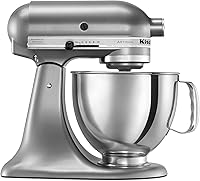
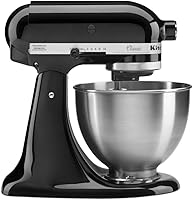
The Artisan and Classic lines are tilt-head mixers. That includes the KitchenAid Artisan 5-Qt Tilt-Head KSM150PS and the KitchenAid Classic 4.5-Qt K45SS.
Both have a hinge at the back and a lever on the side that locks the head down while mixing.
The tilt-head design lets you press a lever and swing the top of the mixer back, so the bowl sits open in front of you. That gives clear access for adding flour, scraping the sides or lifting the bowl out.
KitchenAid lists both models with a 10-speed slide control. The Artisan comes with a pouring shield, which keeps flour in the bowl when you tip ingredients in.
The Classic includes a coated flat beater, a coated dough hook and a 6-wire whip.
These are the mixers most people picture when they think of a KitchenAid. They are the smaller, lighter end of the range and the ones sold in the widest range of colors.
Which KitchenAid models use a bowl-lift?
Bowl-lift mixers keep the head fixed and move the bowl up into it. The KitchenAid 7-Qt Bowl-Lift KSM70SKXX is the clear example, and KitchenAid builds other bowl-lift sizes on the same idea.
A lever on the base raises the bowl so the beater sits down into it.
The bowl locks at three points on the 7-Qt model, which KitchenAid says gives stability for heavy, dense ingredients. There is no hinge to swing, so the head stays put and the mixing action happens as the bowl rises.
KitchenAid describes this model as having twice the power in the bowl of its tilt-head mixer when measured at peak horsepower above speed 2. It runs 500 watts and offers 11 speeds, including a half speed for folding.
That design puts the bulk of the machine lower and the bowl higher. The result is a taller, wider mixer than the Artisan, with a fixed head that never needs clearance to swing back.
How do you tell the two designs apart at a glance?
Look for the hinge and the lever. A tilt-head mixer has a hinge at the back of the head and a lever on the side you press to release it.
A bowl-lift mixer has two arms up the sides and a lever at the base that raises the bowl.
If the head can be pushed back by hand, it is a tilt-head. If the head is fixed and the bowl moves, it is a bowl-lift.
KitchenAid model names usually hint at the answer, with "tilt-head" or "bowl-lift" in the title.
A quick check of the dimensions also helps. Tilt-head models tend to be shorter and narrower.
Bowl-lift models stand taller because the bowl rises under the head.
If the mixer is already on your counter and you are unsure, try lifting the bowl slightly. A bowl-lift bowl is designed to move on its arms.
A tilt-head bowl sits flat and lifts straight out once the head is up.
Is a tilt-head mixer easier to use for everyday baking?
For most everyday mixing, the tilt-head is easier. You press the lever, the head swings back and you have a clear view into the bowl.
Adding ingredients, scraping the sides and checking the dough are all simple from the front.
The Artisan 5-Qt has a 5-quart bowl and 10 speeds, which suits cookies, cakes, frosting and light doughs. KitchenAid says it can mix 9 dozen cookies in a batch using the flat beater.
The Classic 4.5-Qt is a step smaller, with a 4.5-quart bowl rated at up to 8 dozen cookies.
The tilt-head format also fits under low cabinets better, since the base sits lower. That makes it a natural fit for smaller kitchens and for anyone who bakes in modest batches.
If space is tight, our guide to the best compact stand mixers for small kitchens covers smaller options.
One thing to plan for is overhead clearance. You need room above the mixer to swing the head back, so measure the gap under your upper cabinets before you buy.
When does a bowl-lift mixer make more sense?
Bowl-lift mixers suit big batches and heavy dough. The 7-Qt KSM70SKXX carries a 7-quart bowl, and KitchenAid says it can mix 13 dozen cookies, knead over 8.5 lbs of bread or mash over 7.5 lbs of potatoes per batch.
The bowl locks at three points, which helps when the dough gets stiff.
The fixed head means no swing clearance is needed above the mixer. Instead, you need room for the bowl to rise on its arms.
The machine is heavier and larger than a tilt-head, so check your counter depth and cabinet height.
The 11 speeds include a half speed that KitchenAid designed for folding delicate ingredients like berries and egg whites without overbeating. That is a useful feature if you bake a lot of sponge cakes or fold-in recipes.
Bowl-lift is the better match if bread is your main use. The combination of capacity, wattage and bowl stability is aimed at dense doughs.
For a closer look at power, our guide to what wattage a stand mixer should have explains how motor size tracks with batch size.
How does bowl size compare across the two designs?
Bowl size is one of the biggest practical differences. The Classic 4.5-Qt has the smallest bowl at 4.5 quarts.
The Artisan 5-Qt steps up to 5 quarts.
The bowl-lift 7-Qt offers 7 quarts.
KitchenAid's cookie counts follow the bowl size. The Classic is rated at up to 8 dozen cookies, the Artisan at 9 dozen and the 7-Qt at 13 dozen.
For bread, only the 7-Qt model's rating of over 8.5 lbs appears in the details.
A larger bowl means fewer batches when you are cooking for a crowd or stocking the freezer. A smaller bowl means less cleanup and less air whipped in when you only need a small batch of cream or frosting.
Match the bowl to your usual batch. If you mostly mix single batches of cake batter, a 5-quart tilt-head is plenty.
If you bake multiple loaves at once or feed a big household, the 7-quart bowl-lift earns its extra size.
What else changes between tilt-head and bowl-lift?
Weight and footprint change with the design. The Classic weighs 22 pounds.
The 7-Qt bowl-lift weighs 28 pounds.
KitchenAid lists the Artisan at 10000 g, which works out to about 22 pounds. Heavier machines are more stable but harder to move.
Our guide to how much a stand mixer weighs covers what that means for lifting and storage. If you plan to keep the mixer in a cupboard and lift it out each time, a lighter tilt-head model is easier to manage.
The 7-Qt bowl-lift runs on 120 volts and draws 500 watts. It has a one-year limited warranty.
The tilt-head models run on 120 volts as well. The Artisan offers 10 speeds and the bowl-lift offers 11.
KitchenAid also builds these mixers to take hub-powered attachments. The Artisan and Classic both accept more than 10 optional attachments, sold separately, such as grinders and pasta makers.
The bowl-lift model accepts 10+ attachments on the same hub.
Which one should you buy?
Buy the tilt-head Artisan 5-Qt for everyday baking, and the bowl-lift 7-Qt for big batches and bread. That is the rule that answers do all KitchenAid mixers have a tilt-head in practical terms: the two designs are built for different jobs.
Pick the Artisan if you want easy bowl access, a wide color choice and a mixer that fits under most cabinets. Pick the Classic if you want the lowest entry point and mostly mix standard recipes.
Pick the 7-Qt bowl-lift if bread dough and large batches are your main use and you have the counter room.
Check the head design before you buy, not after. The model name and the hinge are your fastest clues.
For a full set of tilt-head options, browse our roundup of the best tilt-head stand mixers.
The key takeaway is simple: KitchenAid makes both types, and neither is the default for the whole brand. The head design should follow your batch size and your kitchen space, not the other way around.
Frequently asked questions
Do all KitchenAid mixers have a tilt-head?
No. KitchenAid makes both tilt-head and bowl-lift stand mixers.
The Artisan and Classic lines use a tilting head, while the 7-Qt KSM70SKXX and other bowl-lift models keep the head fixed and move the bowl up and down instead.
How can I tell if a KitchenAid mixer is tilt-head or bowl-lift?
Look at the top of the mixer. A tilt-head has a hinge at the back and a locking lever you press to raise the head.
A bowl-lift has two arms on the sides and a lever at the base that raises the bowl.
Is bowl-lift better than tilt-head?
Bowl-lift mixers hold larger bowls and heavier dough, so they suit big batches and frequent bread baking. Tilt-head mixers give easier access to the bowl and take up less height, which helps in smaller kitchens and for everyday mixing.
Which KitchenAid mixer is best for bread?
The 7-Qt Bowl-Lift KSM70SKXX is the stronger choice for bread. KitchenAid says it kneads over 8.5 lbs of bread, and its 500 watts and 7-quart bowl handle heavy dough better than the smaller tilt-head models.
Can I use the same attachments on a tilt-head and a bowl-lift mixer?
Most hub-powered attachments fit either type, since the front power hub is shared. Beaters, dough hooks and whisks are not interchangeable, because each set is shaped for its own bowl size and drive system.
Does a tilt-head mixer take up more counter space than a bowl-lift?
A tilt-head needs clearance above it to raise the head, while a bowl-lift needs room to lift the bowl. The Artisan 5-Qt measures 14.1 in deep by 8.7 in wide by 13.9 in high, and the 7-Qt bowl-lift is larger at 14.63 in deep by 11.31 in wide by 16.5 in high.