How Often Do KitchenAid Stand Mixers Break?
Most KitchenAid stand mixers don't break often. With normal home use and basic care, a mixer usually runs for years, and the failures people run into tend to follow heavy dough loads, overfilling or skipped cleaning.
On this page (8 sections)
- What usually causes a KitchenAid stand mixer to fail?
- How long should a KitchenAid stand mixer last?
- Do tilt-head and bowl-lift mixers break at different rates?
- Which KitchenAid models are the most reliable picks?
- What upkeep keeps a KitchenAid mixer running?
- Does using attachments affect how often a mixer breaks?
- How do you know when a repair beats a replacement?
- The bottom line on KitchenAid breakage
How often do KitchenAid stand mixers break? Not often, for most home bakers.
A KitchenAid mixer used for cakes, cookies, frosting and the occasional loaf usually runs for years, and the breakdowns people run into tend to follow a pattern: stiff dough, too much batter in the bowl or skipped cleaning. Treat the mixer as a long-term tool and the question becomes less about failure and more about upkeep.
What you can judge is how each model is built and what it asks of you in return.
What usually causes a KitchenAid stand mixer to fail?
Heavy dough and overloading cause most failures. A mixer asked to knead stiff bread dough week after week works its motor and gears far harder than one whipping cream or creaming butter.
The second common cause is too much batter in the bowl, which strains the motor and can splash past the pouring shield.
The third is simple neglect. Flour packed into the head, a bowl rim left dirty or a cord left coiled tightly all shorten the life of a machine that would otherwise keep going.
None of these are design flaws. They are the normal wear points of a mechanical appliance.
The good news is that the failure is usually gradual, not sudden. A mixer that starts to slow under load or run louder is telling you something before it stops.
How long should a KitchenAid stand mixer last?
Expect years of steady use, not months. KitchenAid builds its mixers around metal construction and a motor sized to the bowl, and the Classic Series lists metal construction and 59 touchpoints around the bowl for thorough mixing.
That build is why the brand's mixers have a long replacement cycle rather than a short one.
The Artisan and Classic are tilt-head designs with 10 speeds. The 7-Qt Bowl-Lift adds 11 speeds and 500 watts, with a heavy-duty build and a 1-year limited warranty.
Different models, different workloads, so the expected life tracks how you use them.
A mixer that kneads bread daily will see more wear than one that appears for birthday cakes. That is true of any brand.
Buy the model sized to your real workload and you won't be asking about breakage for a long time.
Do tilt-head and bowl-lift mixers break at different rates?
The bowl-lift design handles heavy dough more comfortably. The 7-Qt Bowl-Lift uses a 3-point locking bowl and 500 watts to mix dense ingredients, and its double flex edge beater scrapes the bowl as it goes.
That stability is why bread-heavy kitchens lean toward bowl-lift models.
Tilt-head mixers are not fragile. The Artisan's tilt-head gives you easy access to the bowl, and the Classic's head locks in place while mixing.
For creaming, whipping and cookie dough, a tilt-head does the job without strain.
The practical rule: match the design to the load. If your week is mostly bread, the bowl-lift is the sturdier choice.
If it's cakes, frosting and the odd batch of cookies, a tilt-head is built for exactly that.
Which KitchenAid models are the most reliable picks?
The Artisan is the safest all-round choice for most kitchens. It has a versatile 10-speed range, a 5-quart bowl and a pouring shield included, and its 10-speed slide control runs from a very slow stir to a fast whip.
That range keeps you from pushing one speed past its comfort zone.
The Classic is the smaller, simpler option. The 7-Qt Bowl-Lift is the heavy-duty one.
Each suits a different kitchen, so the "most reliable" answer depends on what you mix.
Best for most home kitchens
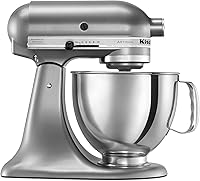
The KitchenAid Artisan 5-Qt Tilt-Head KSM150PS balances capacity and control. A 5-quart bowl, 10 speeds and a tilt head that lifts out of the way make it easy to add ingredients, and the included pouring shield keeps the counter cleaner.
For a kitchen that bakes a few times a week, this is the mixer to start with.
If you are weighing whether the price is justified, our look at whether KitchenAid stand mixers are worth it covers that decision in full.
Best for small kitchens and light baking
The KitchenAid Classic 4.5-Qt K45SS is the compact pick. Its 4.5-quart stainless bowl handles up to 8 dozen cookies in a single batch, and the bowl is dishwasher safe.
The coated flat beater, dough hook and 6-wire whip cover the basics without extra attachments.
Best for bread and heavy dough
The KitchenAid 7-Qt Bowl-Lift KSM70SKXX is built for dense work. It kneads over 8.5 lbs of bread and mixes 13 dozen cookies per batch, and its 1/2 speed folds delicate ingredients without overbeating.
The double flex edge beater scrapes the bowl for thorough incorporation.
Our comparison of the Breville stand mixer vs KitchenAid is useful if you are choosing between brands at this size.
What upkeep keeps a KitchenAid mixer running?
Clean it after each use and respect its limits. Wipe the head and base with a damp cloth, wash the bowl and attachments as the manual directs, and never immerse the mixer body.
Flour and sugar left in the head can harden and work into the gears.
Follow the batch limits. The flat beater ratings are measured with 28g dough pieces, so treat the stated cookie counts as a ceiling, not a target.
When a recipe calls for more, split it into two batches.
Check the cord and plug now and then. A cracked cord or a loose plug is a real safety issue and an easy fix.
Store the mixer with the cord loosely coiled, not wrapped tight around the base.
Does using attachments affect how often a mixer breaks?
Attachments add load to the same motor. The power hub on these mixers runs food grinders, pasta makers and more, and each one asks the motor to do extra work.
The Classic and Artisan both accept 10-plus attachments sold separately.
That is fine when you use them as intended. Grinding meat or rolling pasta for an hour puts more strain on the mixer than a five-minute whip.
Give the motor a break between long attachment jobs.
Clean attachment hubs and shafts as directed so flour and dough don't build up where they connect. A hub that jams is a nuisance, not usually a motor failure.
How do you know when a repair beats a replacement?
Repair when the fault is small and the body is sound. A speed control that sticks, a noisy gearbox or a wobbly head are the kinds of faults that a service visit can fix.
If the housing or base is cracked, or the bowl seat is damaged, replacement is the simpler path.
Compare the repair cost to a new mixer of the same size. If the quote lands close to the price of the model, buying new gets you a fresh warranty and current parts.
Check the warranty first. The 7-Qt Bowl-Lift carries a 1-year limited warranty, and coverage varies by model.
A fault inside the warranty period should go to the brand's service, not a third-party repair.
If you are shopping across brands and want to see how the alternatives stack up, our guide to stand mixer brands and what each does well puts them side by side. And if a compact mixer with a large bowl is what you need, the VIVOHOME 6-quart stand mixer review is a useful read.
The bottom line on KitchenAid breakage
How often do KitchenAid stand mixers break? Rarely, when the mixer matches the workload.
Choose the model for what you actually make, keep batches within the stated limits and clean it after use.
The failures that do happen trace to heavy dough, overloading and neglect, not to a fragile design.
Pick the Artisan for everyday baking, the Classic for small kitchens and light batches, and the 7-Qt Bowl-Lift for bread and dense dough. Buy for your real workload and the mixer should serve you for years.
Frequently asked questions
Is it normal for a KitchenAid stand mixer to get warm while mixing?
Some warmth is normal during long mixing, especially with stiff dough. If the housing gets hot to the touch or the motor slows and smells hot, stop, let it cool and mix in smaller batches.
Can I leave my KitchenAid stand mixer plugged in?
You can leave it plugged in between uses if the cord and outlet stay dry. Unplug it for cleaning and when you change attachments, and keep the speed control at off before you reconnect it.
Does the bowl-lift design last longer than tilt-head?
The bowl-lift design is built for heavier, denser mixing, so it takes stiff dough more comfortably than a tilt-head. For light and medium batches, a tilt-head mixer is not more fragile in any way you would notice.
When should I replace a KitchenAid stand mixer instead of repairing it?
Replace it when the repair cost approaches the price of a new mixer or the housing, base or bowl is damaged. A failed speed control or a noisy gearbox on an older mixer is usually a repair decision, not a replacement one.