7 Best Stand Mixers for Cake Baking (November 2026)
The best stand mixers for cakes and lighter batters include the Martha Stewart 5.3QT Tilt Head Stand Mixer for most cake bakers, the CKemu Stand Mixer for small kitchens, and the VIVOHOME 6-Qt Tilt-Head for large batches.
On this page (8 sections)
The best stand mixer for cake baking is the Martha Stewart 5.3QT Tilt Head Stand Mixer, thanks to its 5.3-quart stainless bowl, 12 speeds and silicone-edge beater that scrapes the bowl as it mixes. For a small counter, the CKemu 3.5-quart model does the job; for big batches, the VIVOHOME 6-quart bowl takes the win.
Cake batter is lighter work than bread dough, so bowl size and speed control matter more than raw motor power. A mixer with a slow first speed folds flour in without a dust cloud, and a beater that reaches the bowl edge saves you stopping to scrape.
If you're still learning the basics of these machines, our stand mixer guide for beginners covers the controls. For a tighter budget, see the stand mixers under 200 dollars.
Our picks at a glance
-
1
 Best for most cake bakers
Martha Stewart 5.3QT Tilt Head Stand Mixer
8.7/10 our score
See it on Amazon -
2

-
3

- 4
 Best for simple layer cakesCheck it
- 5
 Best for single-layer cakesCheck it
- 6
 Best for beginnersCheck it
- 7
 Check it
Hamilton Beach Classic 4-Qt Stand and Hand
Best for small kitchens with one appliance
The best stand mixers for cake baking
Every mixer here includes beaters for cake batter and a whisk for meringue and frosting. The differences come down to bowl size, speed count and how easily you can reach into the bowl while mixing.
Martha Stewart 5.3QT Tilt Head Stand Mixer: Best for most cake bakers
- 5.3-quart stainless steel bowl
- 12 speed settings
- Tilt-head design
- Removable splash shield with pour chute
- Flat beater with silicone edge
A roomy bowl and 12 speeds give you gentle folding for sponge and steady creaming for butter cakes. The tilt head and splash shield keep batter inside the bowl.
Pros
- 12 speeds for fine control over batter texture
- Silicone-edge beater scrapes the bowl as it mixes
- Splash shield with pour chute
- Dishwasher-safe accessories
Cons
- Larger bowl than most here at 5.3 quarts
- Tilt head needs overhead clearance
Martha Stewart's 5.3-quart mixer is the pick for most cake bakers because the bowl handles a full two-layer cake plus frosting without a second batch. The stainless bowl and the flat beater with a silicone edge mean you stop less often to scrape down the sides.
Twelve speeds give you gentle folding for sponge and steady creaming for butter cakes. A removable splash shield with a pour chute lets you add flour with the mixer running.
The three included attachments cover cake work from start to finish: the flat beater for batter, the whisk for egg whites and whipped cream, and the dough hook if you also bake bread.
The tilt head lifts for easy access to the bowl, and the heavy-duty base keeps the mixer steady during long creaming. At 9 lb with a slim profile, it fits smaller kitchens better than its bowl size suggests.
The easy-grip bowl handle makes pouring batter into a prepared pan steadier, which matters when you're working with a runny sponge.
The trade-off is the bowl size: 5.3 quarts is more than a single-layer cake needs. If you mostly bake 6-inch rounds, a compact model wastes less bowl space.
And because the head tilts back, you need open counter height above the mixer to lift it.
CKemu Stand Mixer: Best for small kitchens
- 3.5-quart stainless steel bowl
- 300W motor
- Multi-speed knob control
- Dishwasher-safe attachments
- Compact 12 x 11 x 7 in footprint
A 3.5-quart bowl and 300W motor cover everyday layer cakes without crowding a small counter. The flat beater, dough hook and whisk all go in the dishwasher.
Pros
- Short 7-inch height fits under most upper cabinets
- Dishwasher-safe bowl and attachments
- Multi-speed control from folding to whipping
Cons
- Small bowl for tiered cakes
- Lighter motor than the larger picks
CKemu suits a baker with limited counter space, because the mixer stands 7 inches tall and measures 12 by 11 inches at the base. It slides under upper cabinets and tucks into a corner when you're done.
The 3.5-quart stainless bowl covers a layer cake or a dozen cupcakes at a time. A 300W motor and multi-speed knob take you from gentle folding to high-speed whipping, and the flat beater, dough hook and whisk all go in the dishwasher.
The stainless bowl is easy to wipe out between a batter and a batch of frosting, so one bowl can carry a whole cake project.
The playful design is a real draw if the mixer sits out on the counter. Its trade-off against the top pick is capacity: 3.5 quarts won't handle a tiered cake or a double batch of frosting.
It is also the lightest-duty option in the middle of this list, so treat it as an everyday cake mixer rather than a workhorse for heavy doughs.
VIVOHOME 6-Qt Tilt-Head: Best for large batches
- 6-quart steel bowl
- 660W copper motor
- 10 speeds plus pulse
- Splash guard pours while running
- Flex-edge beater
The biggest bowl here handles double batches and sheet cakes in one go. The 660W motor and pulse setting give you extra power for stiff buttercream.
Pros
- 6-quart bowl for big cakes and double batches
- 660W motor with a pulse setting
- Flex-edge beater scrapes the bowl
- Splash guard lets you pour while mixing
Cons
- Tallest and deepest pick here
- Heavier than the compact models
VIVOHOME is the choice when one bowl needs to do a lot of work. The 6-quart steel bowl holds double batches and sheet cakes, and the 660W copper motor gives you extra power for stiff buttercream.
The bowl is rated for about 2.2 lbs of flour or three bread loaves, which tells you how much batter it can carry without crowding.
Ten speeds plus a pulse setting give fine control. The flex-edge beater scrapes the sides and bottom as it mixes, and the upgraded splash guard lets you pour while the mixer runs.
An egg separator is included too, handy when a sponge calls for yolks and whites separated.
Planetary mixing delivers smooth, lump-free batter. Suction cups keep the base steady, and VIVOHOME lists an 80 dB noise level, so it is not a whisper-quiet machine during long creaming.
That is the price of the bigger motor.
The trade-off is size: this is the tallest and deepest mixer here, so measure your counter and overhead clearance first. For a big family or a busy cake habit, the extra bowl room is worth the footprint.
Hamilton Beach 4-Qt 7-Speed: Best for simple layer cakes
- 4-quart stainless steel bowl
- 7 speeds with slow first speed
- 300W motor
- Planetary mixing action
- Built-in carry handle
A 4-quart bowl and 7 speeds suit basic sponge and butter cakes. The slow first speed folds dry ingredients in without a flour cloud.
Pros
- Slow first speed reduces splatter when adding flour
- Mixing guide on top of the mixer
- Carry handle for lifting and storing
- Dishwasher-safe bowl and attachments
Cons
- No tilt head for bowl access
- 7 speeds give less control than 12
Hamilton Beach's 4-quart model is the straightforward pick for layer cakes and cookies. Seven speeds with a slow first speed help you add dry ingredients without splatter, and a mixing guide on top of the mixer shows the right speed for each job.
For a new baker, that printed guide removes a lot of guesswork about when to cream and when to fold.
Planetary mixing rotates the beaters around the bowl for full coverage. The stainless bowl has handles, and the bowl, splash guard and attachments are all dishwasher safe.
The 300W motor handles cake batter comfortably and can knead bread dough in smaller amounts.
The built-in carry handle makes the mixer easier to lift onto the counter and move to storage. At 8 lb it is lighter than the Martha Stewart and VIVOHOME models, so hauling it out for a weekend bake is less of a chore.
Its trade-off against the top picks is the lack of a tilt head, which makes reaching into the bowl less convenient when you need to scrape down the sides.
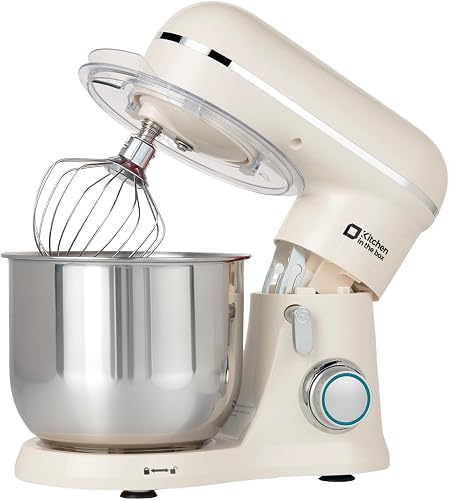
Kitchen in the Box 3.2-Qt: Best for single-layer cakes
- 3.2-quart stainless steel bowl
- 6 speeds
- 300W motor
- Tilt-head design
- 4 anti-slip suction feet
The smallest bowl here suits one-layer cakes and small batches of frosting. Its 300W motor and 6 speeds keep the footprint light and the counter steady.
Pros
- Weighs under 7 lb, so it's easy to move
- Tilt head for easy bowl access
- 4 suction feet keep it stable
- Transparent anti-splash lid
Cons
- 3.2-quart bowl limits you to small batches
- 6 speeds is the fewest here apart from the Hamilton Beach Classic
Kitchen in the Box's 3.2-quart mixer is for small households and single-layer cakes. The bowl makes a modest batch of batter or frosting, and the mixer weighs under 7 lb, so moving it in and out of a cabinet is easy.
Its 12.9 by 7 by 10.2 inch footprint is the narrowest here, which helps on a cramped counter.
Six speeds cover mixing bread dough, thick batters and whipped cream. Four suction feet keep the base steady, and the tilt head opens the bowl for adding ingredients.
A transparent anti-splash lid keeps flour inside, and a gasket at the top joint stops batter splashing into the attachment socket.
The clear trade-off is capacity. This bowl is designed for new bakers and one or two people, so skip it if you regularly bake large batches or tiered cakes.
Six speeds also give you fewer stops between folding and whipping than the 12-speed top pick.
Kitchen in the Box 3.5-Qt: Best for beginners
- 3.5-quart stainless steel bowl
- 10 speeds
- 300W motor
- Planetary mixing action
- Dishwasher-safe accessories
A 3.5-quart bowl with 10 speeds gives a new baker room to learn creaming and folding. It weighs under 5 lb, so lifting it onto the counter is no chore.
Pros
- 10 speeds for the price of a compact mixer
- Weighs under 5 lb
- Splash guard included
- Bowl fits in the refrigerator
Cons
- Bowl makes about 12 cupcakes at a time
- Less power than the bigger bowls here
The 3.5-quart Kitchen in the Box mixer gives a beginner more speed choices than most compact models. Ten speeds and a 300W motor with planetary mixing handle creaming, folding and whipping.
Planetary action means the beater travels around the bowl rather than spinning in one spot, so batter at the edge gets worked too.
It weighs under 5 lb, so it's light enough to lift with one hand. The bowl fits in the refrigerator, which helps when a recipe calls for chilling batter.
A splash guard and dishwasher-safe accessories make cleanup quick. The bowl makes up to one loaf of bread, two pizzas or 12 cupcakes at a time.
That's fine for everyday baking but tight for a celebration cake. The pastel finish also suits a kitchen where the mixer stays on display.
Pick it as a first mixer, not as your only mixer for big projects.
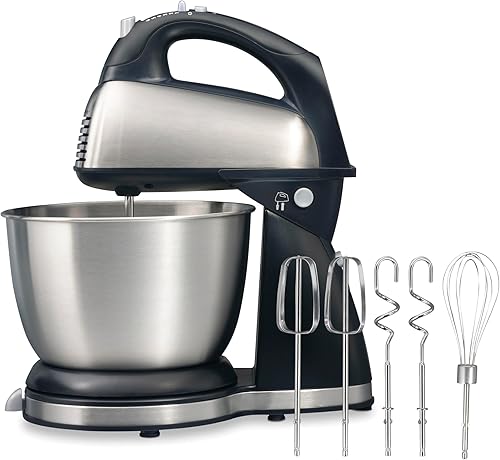
Hamilton Beach Classic 4-Qt Stand and Hand: Best for small kitchens with one appliance
- 4-quart stainless steel bowl
- 6 speeds with QuickBurst
- 290W peak power
- Detachable hand mixer
- Shift and Stir bowl lever
The stand base holds a 4-quart bowl for cake batter, and the head lifts off as a hand mixer for frosting and quick jobs. It saves counter space for bakers who want both tools.
Pros
- Stand and hand mixer in one appliance
- Shift and Stir lever moves the bowl
- QuickBurst button adds power at any speed
- Dishwasher-safe bowl and attachments
Cons
- 6 speeds gives less control than the top picks
- Hand mixer part needs its own storage spot
Hamilton Beach's Classic is the space-saver pick for bakers who want two tools in one. The stand base holds a 4-quart bowl for cake batter, and the head opens as a hand mixer for frosting or a quick whip.
That means one appliance covers both the heavy mixing and the finishing jobs that a stand mixer can struggle with in a small bowl.
Six speeds with QuickBurst cover folding through whipping. A Shift and Stir lever moves the bowl side to side for thorough mixing, and the bowl and attachments are dishwasher safe.
The set includes two traditional beaters, two dough hooks and a whisk, so the hand mixer half is fully kitted out for frosting and meringue.
The trade-off is control: six speeds is fewer than the top picks, so very delicate folding takes a lighter touch. The detachable hand mixer also needs its own storage spot.
For a small kitchen that can't hold both a stand and a hand mixer, it earns its place.
How these cake mixers compare
The table lines up bowl size, speed count and bowl material so you can see at a glance which mixer fits your cake habit.
| Product | Best for | Capacity | Speeds | Bowl material | Our score |
|---|---|---|---|---|---|
| Martha Stewart 5.3QT Tilt Head Stand Mixer | most cake bakers | 5.3 quarts | 12 | Stainless steel | 8.7 |
| CKemu Stand Mixer | small kitchens | 3.5 quarts | Stainless steel | 8.4 | |
| VIVOHOME 6-Qt Tilt-Head | large batches | 6 quarts | 10 plus pulse | 7.7 | |
| Hamilton Beach 4-Qt 7-Speed | simple layer cakes | 4 quarts | 7 | Stainless steel | 7.3 |
| Kitchen in the Box 3.2-Qt | single-layer cakes | 3.2 quarts | 6 | Stainless steel | 6.8 |
| Kitchen in the Box 3.5-Qt | beginners | 3.5 quarts | 10 | Stainless steel | 6.7 |
| Hamilton Beach Classic 4-Qt Stand and Hand | small kitchens with one appliance | 4 quarts | 6 | Stainless steel | 6.6 |
How we compared these stand mixers
We ranked these mixers on the specs that matter for cake batter: bowl capacity, number of speeds, beater design and how easy the bowl is to reach. A silicone-edge or flex-edge beater counts in a mixer's favor because it scrapes the bowl as it mixes.
Bowl size carried the most weight. A 4- to 5.3-quart bowl covers most home layer cakes, while a 6-quart bowl earns points for double batches.
Compact 3- to 3.5-quart bowls suit small kitchens but lose ground on capacity.
We also checked what comes in the box. Every mixer here includes beaters for cake batter and a whisk, and most add a dough hook and splash shield.
Mixers with a tilt head scored higher for cake work because you can reach the bowl with one hand.
Footprint and weight counted too. A mixer that fits under your cabinets and is light enough to move gets used more often than one that lives in a closet.
We weighed stated dimensions and item weight against the bowl size each model offers.
Our score weighs specs, features and buyer feedback against what you're shopping for. It is a fit score, not a lab measurement, so a small mixer that matches your kitchen can outrank a bigger one that does not.
What bowl size works for the cakes you bake?
Match the bowl to your usual batch, not to the biggest cake you might bake once a year. A 4- to 5-quart bowl covers a two-layer cake and a batch of frosting for most households.
Bowl size also decides how much headroom you have when folding, since a bowl filled near the rim is hard to work in without spilling.
3 to 3.5 quarts: single layers and small households
These bowls make one layer, 12 cupcakes or a small batch of buttercream. They suit one or two people and kitchens where counter space is tight.
The CKemu and both Kitchen in the Box models sit here. Their light weight is part of the appeal, since lifting a 5 lb mixer onto a shelf is a quick job.
4 to 5.3 quarts: most layer cakes and family baking
This is the sweet spot for home cake baking. A 4-quart bowl handles a standard layer cake, and 5.3 quarts leaves room for folding without overflow.
The Hamilton Beach 4-Qt and the Martha Stewart 5.3QT fit here. The extra quart and a bit in the Martha Stewart bowl is what lets it mix a full cake plus frosting in one go.
6 quarts and up: tiered cakes and double batches
Pick a 6-quart bowl when you bake sheet cakes, tiered cakes or two batches of batter in one go. The VIVOHOME 6-Qt is the only mixer here in this range, and it also brings the strongest motor.
The larger bowl is heavier to lift and takes more counter depth, so it rewards people who bake often enough to use the room.
How much speed control does cake batter need?
Five speeds is the floor for cake baking, and more speeds give you finer control over creaming and folding. A slow first speed matters most, because it keeps flour from flying out when you add it to wet ingredients.
Creaming butter and sugar also wants a steady middle speed so the mixture turns pale without warming up too fast.
Twelve speeds, as on the Martha Stewart, let you fold egg whites in gently and cream butter at a steady medium. Seven speeds, as on the Hamilton Beach 4-Qt, are enough for basic sponge and butter cakes.
Six speeds, as on the Kitchen in the Box 3.2-Qt and the Hamilton Beach Classic, cover the basics but leave less room for fine tuning.
A pulse setting, found on the VIVOHOME, is handy for short bursts when you're finishing a batter. If you bake often, more speeds are worth it.
For occasional layer cakes, five to seven is plenty.
Tilt head or fixed head for cake baking?
A tilt head is the easier choice for cakes. You lift the top and the bowl stays put, so you can scrape the sides or add ingredients with one hand.
That matters most when you're folding flour in by hand at the end, because you can hold a spatula in one hand and lift the head with the other.
The Martha Stewart, CKemu, VIVOHOME and both Kitchen in the Box mixers have tilt heads. The two Hamilton Beach models use a fixed head with a moving bowl or a lift-off hand mixer, which takes a little more practice to scrape cleanly.
Tilt heads also need overhead clearance to open. If your upper cabinets sit low, measure the open height before you buy.
A fixed-head model or a compact tilt head like the CKemu may fit better.
Which attachments matter for cake recipes?
A flat beater is the attachment you'll use most for cake batter, and a whisk is essential for meringue and whipped cream. Every mixer here includes both.
The beater does the creaming and the batter mixing, while the whisk takes over once you beat egg whites or whip cream for the filling.
The silicone-edge beater on the Martha Stewart and the flex-edge beater on the VIVOHOME scrape the bowl as they turn, which cuts down on stopping to spatula the sides. A dough hook is useful if you also bake bread, and most mixers here include one.
The VIVOHOME and Hamilton Beach Classic sets add an egg separator and extra beaters, which help when a recipe splits yolks from whites.
A splash shield is a small feature with a big payoff when you add flour or cocoa. The Martha Stewart shield has a pour chute, and the VIVOHOME guard lets you pour while the mixer runs.
Dishwasher-safe bowls and attachments make cleanup faster after a frosting session. Check the included components list before you buy, because a mixer without a whisk will leave you whipping cream by hand.
Verdict
The Martha Stewart 5.3QT Tilt Head Stand Mixer is the best stand mixer for cake baking for most people, with a bowl and speed range that fit layer cakes, frosting and the occasional double batch. Choose the VIVOHOME 6-Qt if you bake big or tiered cakes, or the CKemu if your counter is short on space.
For a first mixer on a small budget, the Kitchen in the Box 3.5-Qt is the gentle starting point.
Our plain-English stand mixer buying guide covers the features beyond cakes. If you're still deciding what a mixer can do in your kitchen, read what a stand mixer is used for before you pick.
Our top 3 picks at a glance
-
1
Best for most cake bakers
Martha Stewart 5.3QT Tilt Head Stand Mixer
8.7/10 our score
See it on Amazon -
2
-
3
Frequently asked questions
What size stand mixer do I need for cake baking?
A 4- to 5-quart bowl covers most layer cakes and buttercream batches for a family. Pick a 6-quart bowl for tiered cakes or double batches.
A 3- to 3.5-quart bowl suits single layers and small households.
How many speeds should a cake mixer have?
Five or more speeds are enough for most cake recipes. More speeds give you finer control when creaming butter and sugar or folding in flour.
Look for a slow first speed so dry ingredients don't fly out of the bowl.
Can a stand mixer handle cake batter and bread dough?
Yes, if it comes with a dough hook as well as a flat beater and whisk. Every mixer here includes a dough hook.
Bread dough is heavier work, so a larger motor and bowl handle it more easily than a compact model.
Is a tilt-head or bowl-lift mixer better for cakes?
A tilt head is easier for cake baking because you can lift it and scrape the bowl with one hand. Bowl-lift mixers suit heavy dough but need two hands and more overhead room.
Most home cake bakers do fine with a tilt head.
Do I need a splash shield for cake batter?
A splash shield helps when you add flour or cocoa to a running mixer. Several mixers here include one, and some let you pour through a chute without lifting the shield.
It saves cleanup on the counter and the mixer body.