How Does a Stand Mixer Work?
A stand mixer works by turning a beater in circles while the bowl turns the opposite way, so the tool reaches every part of the mix without you scraping the sides. A motor drives the beater through gears and belts, and the mixing head holds the bowl and the attachments.
On this page (8 sections)
- What are the main parts of a stand mixer?
- How does planetary mixing cover the whole bowl?
- What do the different speeds do?
- What does each attachment do?
- How do the tilt-head and bowl-lift designs differ?
- How do the controls and the motor work together?
- Which jobs is a stand mixer actually built for?
- What should you check before you buy one?
A stand mixer works by spinning a beater in circles while the bowl turns the opposite way, so the tool sweeps every part of the mix without help from you. A motor drives the beater through gears, the head holds the bowl in place, and the speed dial changes how fast all of it moves.
That double motion is the whole idea. A hand mixer moves only its beaters, so you drag it around the bowl.
A stand mixer moves the beaters and the bowl against each other, which is why it can knead dough or whip cream while you do something else. If you want the wider picture of what the machine is good for, our guide to what a stand mixer is used for covers the jobs.
What are the main parts of a stand mixer?
The motor, the mixing head, the bowl and the attachment hub are the core parts. Each one has a clear job, and knowing them makes the controls much less confusing.
The motor sits in the base or the head and provides the turning power. The mixing head carries the beater shaft and either tilts up or stays fixed while the bowl rises to meet it.
The bowl holds the ingredients and locks onto the base.
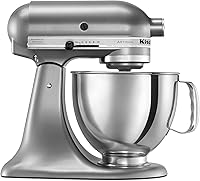
On the front of many tilt-head mixers there's a hub that powers optional tools. A KitchenAid Artisan, for example, has 10 speeds and a hub that takes add-on attachments.
The Cuisinart 5.5-Qt runs 12 speeds and offers one power outlet for optional tools. Below the bowl is the base, often with suction feet or a heavy cast body to stop the machine walking across the counter.
How does planetary mixing cover the whole bowl?
Planetary action means the beater travels around the bowl in its own circle while the bowl turns, so the two paths combine. The beater traces a ring inside the bowl's edge instead of staying in one spot.
Think of the beater as a planet orbiting a center point while the bowl itself rotates beneath it. The flat beater's wide blade pushes batter against the bowl wall on each pass, then pulls it back toward the middle.
The whisk works the same way, but its wire loops drag air into the mix as they go.
This is why a stand mixer needs less stopping and scraping than a hand mixer. It's also why a slow first speed matters: the mix starts folding before the speed climbs.
The Hamilton Beach 4-Qt uses this same planetary motion, and it's the reason a smaller mixer can still cover its bowl evenly.
What do the different speeds do?
Low speeds mix and knead, middle speeds cream and blend, and high speeds whip and aerate. The dial spreads those jobs out so each one gets the right amount of power.
On a 10-speed KitchenAid, the bottom settings stir and knead gently, while the top end is built for a very fast whip. The Cuisinart's 12 speeds give more steps in between, which helps when a recipe wants a slow fold rather than a sudden jump.
The Hamilton Beach 7-Speed keeps a slow first setting for adding dry ingredients without a cloud of flour.
The pattern holds on every mixer. Start low so ingredients don't fly out, move up once the mix comes together, and only reach the top end when the job is aeration.
A single high burst won't ruin a batter, but running thick dough at top speed for minutes on end works the motor harder than it needs to.
What does each attachment do?
The flat beater mixes batters and frostings, the dough hook kneads bread, and the whisk whips air into light mixtures. Most mixers ship with all three, so you rarely need to buy a tool separately.
The flat beater
The flat beater has a broad blade and suits cake batter, cookie dough, mashed potatoes and frosting. It scrapes close to the bowl as it turns, so it handles anything thick enough to need a firm push.
KitchenAid includes it with the Artisan, and Cuisinart ships a flat mixing paddle in its set.
The dough hook
The dough hook is a curved arm that stretches and folds dough against the bowl wall. It works best at low speed over several minutes, which builds gluten without heating the dough.
It's the tool that makes a stand mixer worth the counter space for bread bakers. If you want to see the hook in action before you start, how to use a stand mixer walks through the speed settings for dough.
The whisk
The whisk is a cage of wire loops that drags air into cream, egg whites and light batters. It needs room and speed to work, so it belongs on the higher settings.
A 5-quart bowl like the one on the KitchenAid Artisan gives cream space to expand. Our guide to how to make whipped cream in a stand mixer shows how the whisk and the speed dial work together.
How do the tilt-head and bowl-lift designs differ?
A tilt-head mixer hinges the top back to open the bowl, while a bowl-lift mixer raises the bowl to the fixed head. Both give you access to the bowl, just in different ways.
The tilt-head design is the more common home layout. You release the head lock, lift it back on its hinge, fit the attachment, and lower it.
It takes less vertical clearance than a bowl-lift, which matters if your counter sits under a cabinet. The KitchenAid Artisan and the Cuisinart 5.5-Qt both use a tilt-head design.
A bowl-lift mixer keeps the head fixed and turns a lever to bring the bowl up to the beater. That makes for a sturdier feel and more room to scrape the bowl, but it needs more height.
Neither design changes how the mixing works, so the choice is about your counter and how often you bake.
How do the controls and the motor work together?
The speed dial sends power from the motor through a gear system to the beater shaft. On most mixers the motor spins fast and the gears slow that down into the steady turn you see at the bowl.
A belt or gear drive also protects the motor. If a spoon or a stiff dough jams the beater, the drive is designed to slip rather than burn out the motor.
That's why the machine can knead for minutes without stalling.
The controls sit at the front or the side, and the speeds are set steps rather than a smooth dial. The KitchenAid Artisan uses a 10-speed slide control, the Cuisinart runs 12 speeds from a knob, and the Hamilton Beach has 7 settings plus a mixing guide on top.
Fewer speeds means bigger jumps between settings, so a recipe that calls for a gentle fold may need a shorter run at the lowest step.
Which jobs is a stand mixer actually built for?
A stand mixer is built for dough, batter, cream and egg whites, the mixes that need steady power and both hands free. It's less useful for small jobs a whisk can finish in seconds.
Bread and cookie dough suit it because the hook and the flat beater keep working while you measure the next batch. Whipped cream and meringue suit it because the whisk needs sustained speed to build volume.
The Hamilton Beach 4-Qt, with its 4-quart bowl and 300-watt motor, covers cupcakes and cookies without taking over the counter.
The bowl size tells you what each mixer handles best. A 5-quart bowl like the KitchenAid Artisan's suits a family batch of dough.
The 5.5-quart Cuisinart bowl holds a little more. The 4-quart Hamilton Beach is the tighter fit for big bread days.
When the bowl runs close to the top, split the batch rather than pushing the motor.
If you're planning a first project, what to make with a KitchenAid stand mixer lists recipes that show off the hook, beater and whisk in turn. That's the quickest way to see how each part of the motion earns its place in the machine.
What should you check before you buy one?
Check the bowl size, the speed count and the head design against how you bake. A 5-quart tilt-head covers most home kitchens; a smaller bowl suits lighter use.
Match the bowl to your usual batch. A 4-quart bowl fits a household of two or three, while a 5.5-quart bowl takes larger batches without a second run.
Then look at the speeds: more settings give you finer control between a slow stir and a fast whip. The head design matters for your counter, since a tilt-head needs less clearance than a bowl-lift.
Finally, count the tools in the box. A mixer that includes the flat beater, dough hook and whisk is ready for bread and cream on day one.
One with a splash guard, like the Cuisinart set, saves cleanup when you add flour.
A stand mixer works by combining a powered beater with a turning bowl, and every part you've read about serves that motion. Pick the bowl size and head design that fit your kitchen, then let the speed dial do the rest.
Frequently asked questions
Does a stand mixer knead dough by itself?
Yes, once you fit the dough hook and set a low speed. The hook stretches and folds the dough against the bowl as the bowl turns, so you can leave it running while you do other things.
Stop it now and then to check that the dough has come together.
Why does the mixing head move up and down on some mixers?
A tilt-head mixer hinges the top up and back so you can reach the bowl. A bowl-lift mixer keeps the head fixed and raises the bowl with a lever.
Both do the same job, and the choice comes down to how much room your counter has.
Can I run a stand mixer at top speed for everything?
No, and that's the point of the speed dial. Slow settings handle dough and thick batters without splashing, while high settings are for whipping cream and egg whites.
Starting a heavy mix too fast strains the motor and throws flour out of the bowl.
Is planetary mixing the same as the bowl turning?
Planetary action means the beater travels around the bowl in its own path while the bowl also turns. That double motion is what covers the whole bowl.
Some mixers spin only the beaters and keep the bowl still, which means more scraping by hand.
What do the hub attachments on the front actually do?
The front hub on many tilt-head mixers powers add-on tools such as meat grinders, pasta rollers and spiralizers. The mixer's motor drives them through the same gears.
You only need one for jobs the bowl tools can't do, so buy them as your cooking changes.