How Much Does a Stand Mixer Cost?
A stand mixer costs anywhere from budget to premium, and the gap comes down to motor power, bowl size and how the bowl locks. A 4-quart 300-watt mixer sits at the budget end, a 5-quart tilt-head in the middle, and a 500-watt 7-quart bowl-lift at the top.
On this page (8 sections)
- What are the three stand mixer price tiers?
- What do you get in a budget stand mixer?
- What does a mid-range stand mixer add?
- What pushes a stand mixer into the premium tier?
- Which stand mixer should you buy on a tight budget?
- How do bowl size and motor power affect what you pay?
- Are hidden costs part of owning a stand mixer?
- What's a realistic stand mixer budget?
A stand mixer costs anywhere from budget to premium, and the gap comes down to motor power, bowl size and how the bowl locks. A 4-quart 300-watt mixer sits at the budget end, a 5-quart tilt-head in the middle, and a 500-watt 7-quart bowl-lift at the top.
So when you ask how much does a stand mixer cost, the honest answer is a range, not one number. Three tiers cover almost every home baker, and each one is tied to a real spec you can check.
What are the three stand mixer price tiers?
Budget, mid-range and premium are the three tiers, and each one maps to a motor size and bowl capacity. The specs tell you where a mixer sits.
The budget tier is small motors and 4-quart bowls. The mid-range tier is a 5-quart tilt-head with 10 speeds.
The premium tier is a bowl-lift design with 500 watts and a 7-quart bowl.
Knowing the tier helps you judge whether a price is fair. A 4-quart mixer with a 300-watt motor and 7 speeds is doing less work than a 7-quart model with 500 watts and 11 speeds, so it should cost less.
What do you get in a budget stand mixer?
A budget stand mixer gives you a smaller bowl, fewer speeds and a lighter frame, which suits cookies, cakes and light bread. The Hamilton Beach 4-Qt 7-Speed is the reference point for this tier.
It has a 300-watt motor and a 4-quart stainless steel bowl with handles. The planetary mixing action turns the beaters around the bowl for hands-free coverage, and there are 7 speeds with a slow first speed for kneading and adding dry ingredients.
The box includes a splash guard, dough hook, whisk and flat beater, and all of those plus the bowl are dishwasher safe. A top handle makes it easier to lift the head and to move the mixer for storage.
It weighs 8 pounds.
This is the tier to start on if you bake a few times a month. For more on picking a first mixer, see our guide to the best stand mixer for beginners.
What does a mid-range stand mixer add?
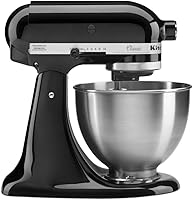
The mid-range tier adds a larger bowl, more speeds and a tilt-head design that lifts the head back to swap tools. The KitchenAid Artisan 5-Qt Tilt-Head KSM150PS is the model that defines this tier.
Its 10-speed slide control runs from a very slow stir to a very fast whip. The 5-quart bowl is removable, and the tilt-head design lets you add ingredients without moving the bowl.
A pouring shield comes in the box.
KitchenAid says the bowl can mix 9 dozen chocolate chip cookies using the flat beater. It's also a hub for optional attachments sold separately, from food grinders to pasta makers.
It's available in over 20 colors.
The step up buys flexibility more than raw power. If you bake weekly and want to add attachments later, this is the tier most people land on.
Our stand mixer buying guide walks through the choices in plain terms.
What pushes a stand mixer into the premium tier?
Premium mixers carry a bowl-lift design, a bigger motor and a much larger bowl, aimed at heavy dough and big batches. The KitchenAid 7-Qt Bowl-Lift KSM70SKXX sits here with 500 watts and 11 speeds.
Its 7-quart bowl handles 13 dozen cookies per batch, over 8.5 lbs of bread, or more than 7.5 lbs of potatoes. A 3-point locking bowl holds steady while you mix dense ingredients, and speed 1/2 is made for folding delicate additions like blueberries and egg whites.
The box includes a stainless steel bowl, a double flex edge beater, a coated flat beater, a coated dough hook, an 11-wire whip and a pouring shield. It weighs 28 pounds and stands 16.5 inches tall.
KitchenAid backs it with a 1-year limited warranty.
This tier earns its place when batch size is the limit, not when you just want a nicer look. Check counter height before you buy, because the bowl-lift head doesn't tilt back.
Our post on how much a stand mixer weighs helps you plan for the heft.
Which stand mixer fits your budget?
If you bake occasionally, the Hamilton Beach 4-Qt 7-Speed covers everyday cakes and cookies at the lowest cost. Its 300 watts and 7 speeds handle thick batters and bread dough for a small household.
If you bake most weeks and want attachments later, the KitchenAid Artisan KSM150PS is the sensible middle. The 5-quart bowl and 10 speeds give you room to grow without the weight of a bowl-lift.
If you bake for a crowd or knead dense dough, the KitchenAid 7-Qt Bowl-Lift KSM70SKXX is the one to save for. The 7-quart bowl and 500 watts do the work a smaller mixer can't.
Which stand mixer should you buy on a tight budget?
Buy the smallest mixer that covers your usual batch size, not the cheapest one on the shelf. A 4-quart bowl holds enough for most home recipes, and a 300-watt motor handles them without strain.
The Hamilton Beach 4-Qt 7-Speed is the clear pick in this tier. Its 7 speeds, slow first speed and mixing guide make it easy to learn on, and the carry handle helps when you store it away.
Skip it if you regularly knead more than a couple of loaves at once. A 4-quart bowl and 300 watts are sized for home batches, not bakery-sized ones.
If your budget can stretch, see our roundup of the best stand mixers under 200 for the next step up.
How much should you spend on a first stand mixer?
Spend in the budget or low mid-range tier for a first mixer. You want a bowl that fits your recipes and speeds you can learn on, and both are covered without paying for a bowl-lift.
The Artisan KSM150PS is the top of that range for most first-time buyers. Its 5-quart bowl, 10 speeds and wide color choice make it a long-term buy rather than a starter you outgrow.
Don't spend on premium features you won't use. A 500-watt bowl-lift is wasted on a baker who makes one cake a month.
How do bowl size and motor power affect what you pay?
Bigger bowls and stronger motors cost more, because both add material and build complexity. The 4-quart Hamilton Beach runs 300 watts and weighs 8 pounds; the 7-quart KitchenAid runs 500 watts and weighs 28 pounds.
Bowl capacity changes how much you can mix in one go. A 4-quart bowl suits cookies and a single cake; a 7-quart bowl mixes 13 dozen cookies or kneads over 8.5 lbs of bread.
Speed count matters too. The budget model has 7 speeds, the Artisan has 10, and the bowl-lift has 11 with a half speed for folding.
More speeds give you finer control over mixing and kneading.
Weight is the hidden cost. A 28-pound bowl-lift needs a stable counter spot and stays put, while an 8-pound mixer is easy to move.
Our weight guide covers what each type means for storage and counter space.
Are hidden costs part of owning a stand mixer?
Plan for attachments and storage, not just the mixer itself. Hub-powered extras like grinders and pasta makers are sold separately on KitchenAid models, so factor those in if you want them.
The mixing tools you need for basic baking usually come in the box. The Hamilton Beach includes a splash guard, dough hook, whisk and flat beater; the two KitchenAid models include a pouring shield and their mixing tools.
Storage is the other cost to think about. A bowl-lift mixer is tall and heavy, so it needs a dedicated counter spot, while a lighter tilt-head can go in a cupboard.
Warranty length is worth checking too. The KitchenAid 7-Qt Bowl-Lift carries a 1-year limited warranty, so weigh that against a longer coverage on a model you plan to keep for years.
One practical tip: measure your counter depth and cabinet clearance before you order, since bowl-lift mixers don't tilt back.
What's a realistic stand mixer budget?
Set your budget by batch size first, then by attachments. If you bake small batches now and then, budget for a 4-quart mixer and save the rest.
If you bake weekly and want to grow, budget for a 5-quart tilt-head.
If you bake in volume or knead dense dough, save for a 7-quart bowl-lift.
That's the honest answer to how much does a stand mixer cost: the tier you buy should match the work you'll ask it to do. Buy the tier you'll use, not the top of the range.
Start with the Hamilton Beach 4-Qt 7-Speed if you're learning. Move to the KitchenAid Artisan KSM150PS when baking becomes a habit.
Save for the KitchenAid 7-Qt Bowl-Lift KSM70SKXX when batch size is your real limit.
Frequently asked questions
How much does a stand mixer cost for a beginner?
A beginner can stay in the budget tier with a 4-quart mixer like the Hamilton Beach 4-Qt 7-Speed. It handles cookies, cakes and bread dough with 300 watts and 7 speeds, so you can learn on it before spending more.
What makes a bowl-lift stand mixer cost more than a tilt-head?
Bowl-lift models usually carry a bigger motor and bowl. The KitchenAid 7-Qt Bowl-Lift KSM70SKXX has 500 watts and 11 speeds against the Artisan's 5 quarts and 10 speeds, and the locking bowl design adds heft and build cost.
Is a more expensive stand mixer worth it?
It's worth it if you bake large batches or dense dough often. A 7-quart bowl-lift kneads over 8.5 lbs of bread, while a 4-quart budget mixer covers everyday home baking at a lower cost.
Do stand mixer attachments cost extra?
Sometimes. The KitchenAid Artisan and 7-Qt Bowl-Lift include a pouring shield and mixing tools, but hub-powered extras like grinders and pasta makers are sold separately.
Budget models like the Hamilton Beach come with a splash guard, dough hook, whisk and flat beater.
How much should I budget for a stand mixer that lasts?
Plan for the mid-range tier if you want a proven tilt-head design with a 5-quart bowl. The KitchenAid Artisan KSM150PS is a 10-speed model with a removable bowl and a wide color range, and it's the safest step up from budget.